blog posts

street photography tips, london street photography, london photography

What does the frame really mean in street photography, and do ratios matter?

The relationship between photographic frame, ratios and observing life as it unfolds

I was recently asked to participate in a collective exhibition in Paris, organised notably by a friend of mine. The problem: the organising team had made the decision to request all selected pictures to be reframed at 4:3 - I assume to fit the frames they had planned to purchase. I carefully considered what my image would look like from my normal 3:2 format to 4:3 - and I just didn’t like it. Something deep inside of me was simply refusing to crop and change the proportions of the image, as it would forever alter the ‘frame’, the composition, and in a sense, my vision for the image.

It was not that it was technically impossible. It was more a matter of principle. 3:2 is how I see the world through my viewfinder. And over the years, I have learned to anticipate this pre-defined frame, to work within the constraints and boundaries of this frame as if it was my window into the world, a window I couldn’t bend nor extend. Early enough in my journey, 3:2 became the technical and artistic boundaries through which I create images. 
The photo that would have been selected at the Paris exhibition, requiring a 4:3 crop.

So I questioned myself further…

What is the relationship between ratios and what we call the frame? Are these rules imposed on myself justified by my vision of street photography? And finally, what difference would this make if my subject was not direct observation of the human world, but - for example - conceptual images?

First, I need to caveat that everything that follows is my opinion and mine only. I have no intention to dictate nor limit what other photographers should do - so if you have a different view and practice, I am curious to know it - share in the comments!

I remember Alex Webb, in The Suffering of Light, explaining that he’s attracted to complex images integrating many interesting elements in the frame. And there lies a delicate balance: putting enough elements who belong to the frame, while keeping out those who do not belong. Many times, he said, the balance would tip over and the image would not work. 

I can’t say that I know much about the practice of Alex Webb - beyond his wonderful images - but I liked how he talked about the ‘frame’. The frame for me is both a physical and metaphorical concept. We often use the word frame to speak about the boundaries of an existing image - regardless of what happened in between the moment of shooting and the editing process itself. There is the frame which are the boundaries of what’s visible - and there is what we can’t see, what’s outside of the frame, therefore outside of the composition. And yet, for me, the concept of ‘frame’ starts well before the final image people see. The frame is the physical, very real limits of my viewfinder. What I have realised is that, in my practice of street photography, I aim to capture what’s happening in front of my eyes - where everything is in constant movement, in and out of sight, changing by the second. My viewfinder - the frame in other words - is like a window on the world, where like Mr Webb, I decide where to position myself within the scene and when to press the trigger based on what I see. 
I shoot through my 3:2 viewfinder, determining the frame and ratios for all of my images.

In practical terms, there is a lot that I don’t see while I shoot - but the boundaries of a familiar, unchangeable frame (which exists by shooting with the same focal length over and over) helps me shoot better images overall. I can readily anticipate where that frame is, even if I decide to shoot from the hip. The functional frame has become a metaphorical window in my mind, after countless photowalks and shots over the years. 

Because I shoot what I see, within established boundaries, it’s only normal that I stick to a consistent ratio when editing (horizontal and its vertical equivalent). Could you shoot one way though, and edit another way? Sure. You could do this. But that’s not how I see street photographs. I like to think of them as the raw product of my observations. I like seeing how the image turned out within this frame, as my eyes often couldn’t quite process the whole scene in front of me. To me, my vision of the image starts very early on: a fixed window across which I see life unfold, I see people moving, entering, leaving. I see a hand, I see feets. I see a shadow. I don’t decide the size or proportion of this window. I only decide when to shoot to optimise what’s within it. In a world that moves too fast around me, the limits of the frame is the only predictable variable I can truly rely upon.

And this is why I shoot, edit and share images in a consistent 3:2 format. It’s both a pragmatic and philosophical decision. It simply makes no sense for me to crop my images differently - my vision has existed from the moment I took the shot, and the frame has always been both technical and metaphorical for me. A window through which life unfolds, in front of my eyes.
The discomfort of change and arriving to a new vision

How I learned to accept what it really feels to change

Growth is uncomfortable. It’s a hard process. It’s a place where the ground that used to be solid starts to evaporate, to sizzle in pieces. But change is inevitable - it’s part of growing as a photographer. So I have learned to embrace that place of discomfort until the world could make sense again. Until I could make sense again. 

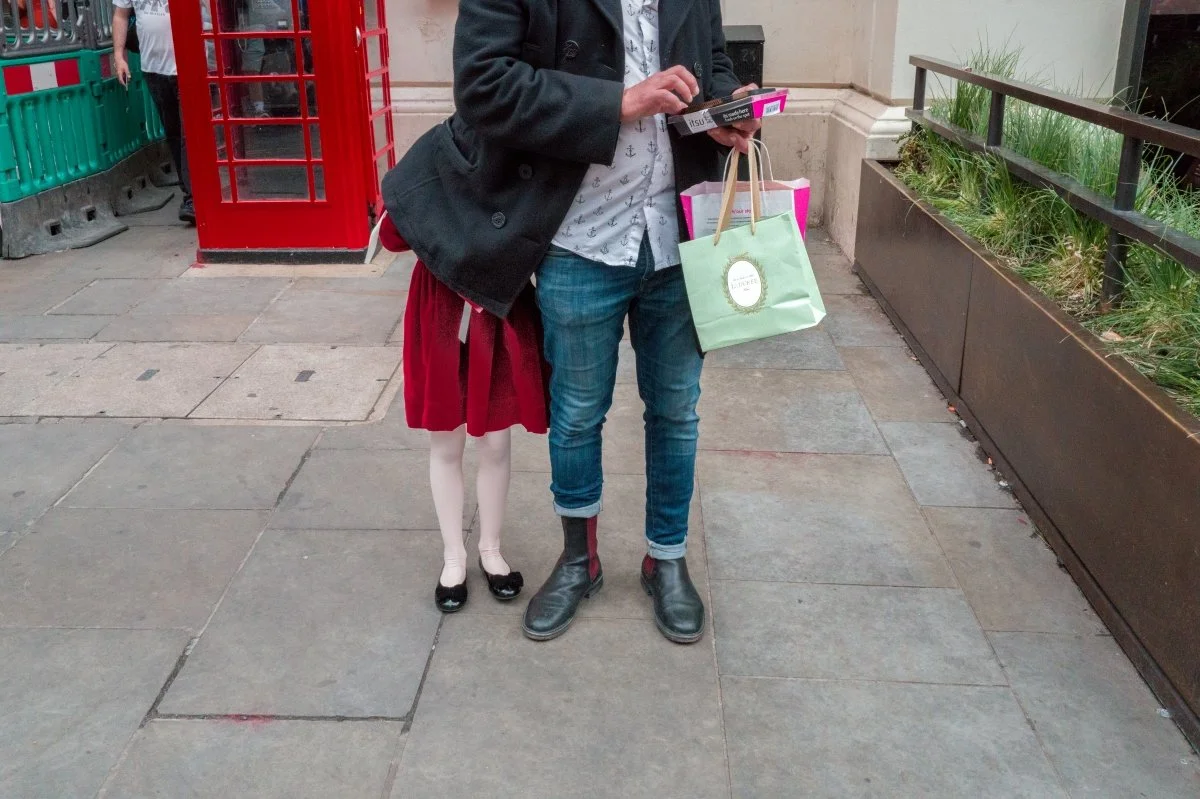
My current work focuses on colour photography - I have finally defined what colour meant to me. This image is part of my London series entitled Eyes Wide Open.

Sometimes it takes effort to find oneself as a photographer. And sometimes it takes courage to change, to evolve, and to recognise that what we used to do doesn’t work anymore. There will be moments in your journey where things will be clear to you - who you are as a photographer, the narrative that you have constructed around your work, even your style or styles will be more sharply defined, recognisable perhaps amongst who follow you.

And there are times where you will feel lost, where nothing quite makes sense. When asked what matters to you as a photographer, you may hesitate. The answer is not yet - or is no longer - coming clearly at you. And this is ok. Tolerating the discomfort of not knowing where we are going is the fate of many of us at some point or another. Only those who never change nor evolve can claim their feelings of confidence. But staying in your comfort zone is not necessarily healthy. It’s not necessarily helpful. And it’s rarely sustainable as it turns out, as humans are not built to remain static, unchanged, unmoved.

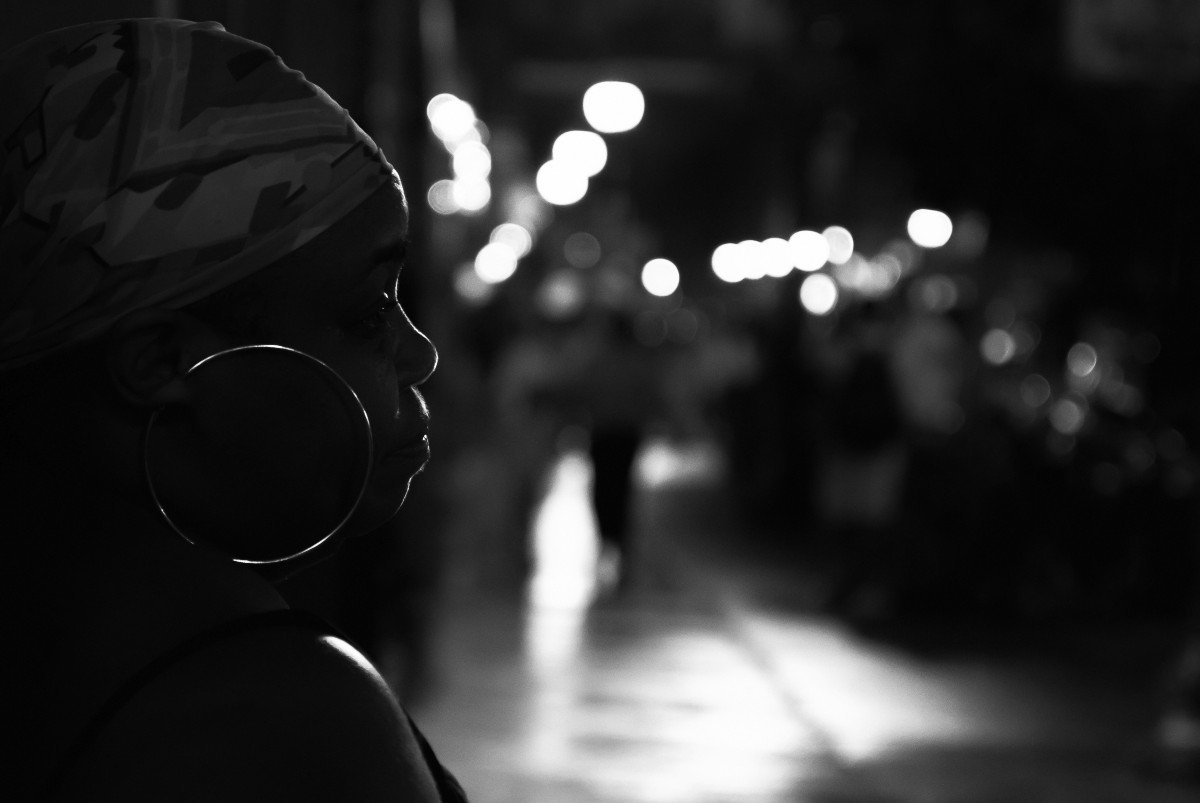
A typical image from my early work in Chicago, followed by a period of black and white in London. I have called this series American Fairytale

While I started street photography in 2012, I developed a clear sense of direction almost from the get go. I had a vision: I only had to look inside of me to know when and what to shoot, as if the world captured was a mirror to my own psyche, to my emotions. I quickly grew in confidence, exhibiting my work in Chicago in 2013 and 2014. Once in London, my style evolved but remained focused on my internal emotional states - purely in black and white as I had done since the beginning. And then in 2017-18, I knew I had to change. Alongside a difficult period in my life, my photography was no longer working. I decided to quit B&W and to shoot in colour…but I had no idea what colour meant to me. What I was without beautiful women in shades of grey, without falling lights and shadows. I only knew that after taking the same image again and again, a drastic change needed to happen. 

But in truth, I didn’t change overnight, no. It took me a few years to get clarity, and emerge on the other side. To know what colour meant to me. To know what was ‘next’. 

Here’s how my vision changed overtime:

For several years, my work was fully projective, in the sense that I was capturing in the external world fragments of my own inner world, emotions, sense of beauty and wonder. My photographs were an expression of what was inside me, the many facets of my identity and fluctutating feelings. My subjects didn’t really exist on their own: they inhabited a world that I had created in my mind. So during this first phase of work, my work was entirely directed towards myself.

Opposite to that, my new projects are all focused on the external world, very much embedded in real life even if still embued with poetry, with definite moments of grace. They take place in a fast moving city full of colours and contradictions, my subjects inhabiting this urban environment with their own weight. Photographs have become more joyful, more about these small understated moments of poetry that only keen observation can reveal. In short, I shifted the focus from myself to others, from internal world to external world. From subjects representing my own emotions to subjects living within and beyond the frame, the city as my main character, independently from myself.

What I learned from this process:

  • It’s ultimately necessary to tolerate discomfort. A photographer needs to learn to survive the lack of inspiration, the struggles and self-doubts, and peaks of demotivation. If looking at your pictures is suddenly becoming hard, uncomfortable, painful even, it is unfortunately all part of the process. 

  • There are two persons in me, and probably in you too: The free spirited shooter living through intuition and mindfulness, and the editor, judging and selecting pictures. Sometimes, these two persons are not aligned and act very differently. My transformation started in 2016-17 - going back to my archives, I discovered many shots aligned with my current vision, completely ignored at the time by the ‘editor’ in me. What I was shooting didn’t align with my judging state of mind, leaving behind several interesting shots as precursors of my work today.

An image from 2018 which I had never processed, until I came back to my archives years later. That’s how I realised that I had been already shooting the same way that I shoot today, without realising this. Change can be a long and opaque process to go through.

A 2025 image that represents very well my intent today as I document small moments happening in the midst of urban chaos in London - a very different approach to my B&W work.

It’s ok to struggle at times, to find yourself in a plateau. If it’s meant to be, you will find inspiration again. It’s often needed to reconnect with yourself, with this free spirited shooter, to make this happen. But trust me: the other side is really worth it. Growing is the motor of our artistic lives, we simply cannot avoid it.

the strange and unfamiliar - part 5

What is Strangeness? A sense of otherness. The opposite of common, ordinary, familiar. Strangeness comes out of capturing human beings and the world in a different, unfamiliar light. In this article, I wanted to explore different ways I have evoked a sense of strangeness and otherness in my photography - and through this, introduce possible avenues for you to explore. I hope you will enjoy this reading, and if so, let me know in the comments!

While there are many ways to think of the strange and unfamiliar, in my next series of articles I will discuss five themes that are close to my heart:

  1. Transforming the relationship between man and the city

  2. Introducing shadows as a destabilizing element

  3. Connecting elements to create tension and parallels

  4. Windows to create distance and a sense of otherness

  5. Using reflections to fully transform the reality


5. Using reflections to fully transform the reality

Reflections are extremely powerful at creating completely re-invented worlds, hiding the most important details, confusing the mind about what is and isn’t, and showing a troubled mirror of our world that can be utterly surrealistic and captivating. Reflective surfaces transform what we see, the essence of reality, the substance of human beings. And this stirs the imagination. Strange, weird, unfamiliar - whether poetic or chaotic, reflections are there to disrupt the harmony through creating powerful illusions. People disappear, replaced by light and shapes. Independent elements get juxtaposed to create a new dimension, a new illusion, as if creating a composite image of two or three existing images. But in street photography, nothing is fabricated and catching these disruptive reflections is an art in and of itself. And more often than not, what the camera will capture is unlike what the eye can see, creating surprising results and allowing the strange and unfamiliar to penetrate our minds, for our greatest delight.

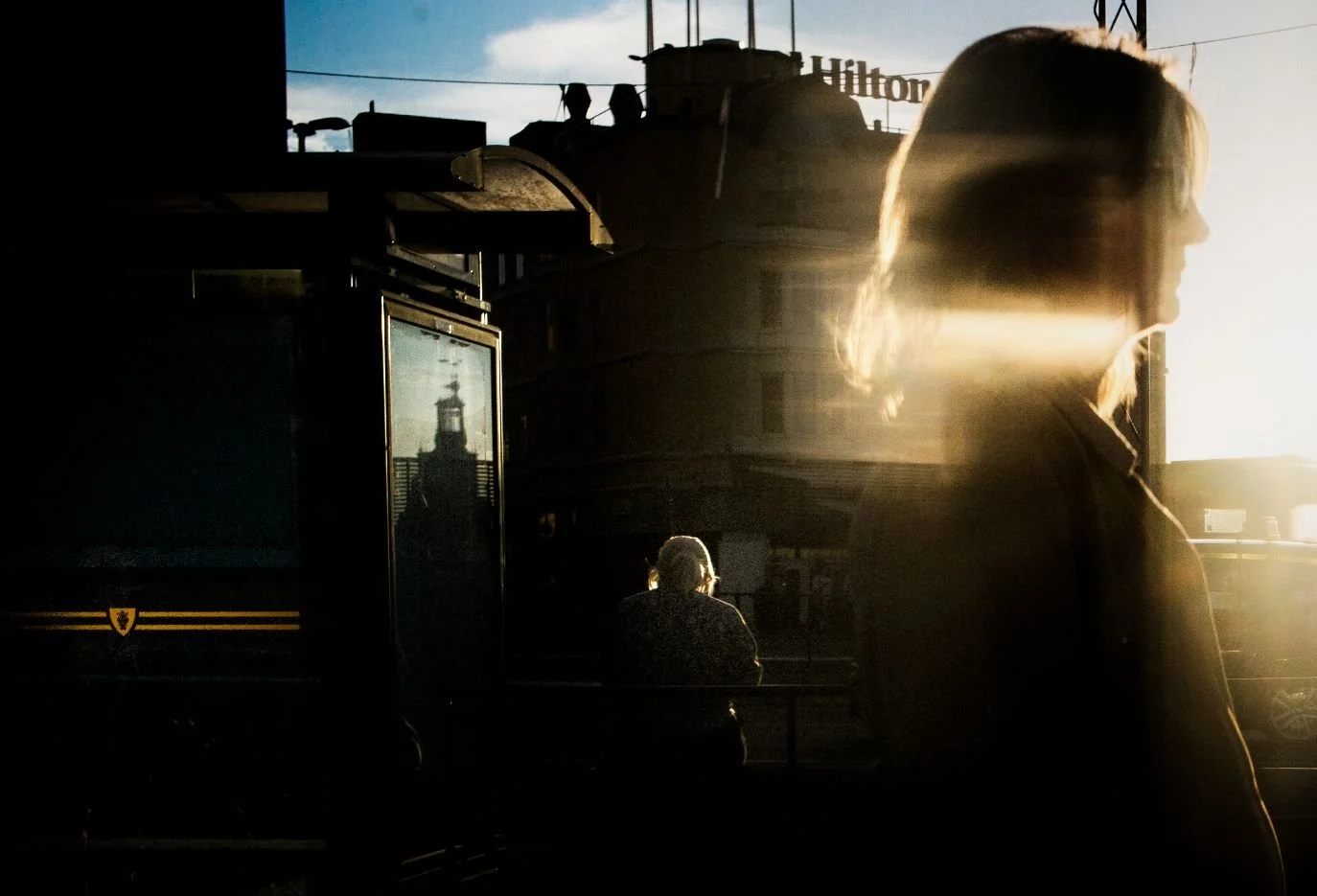
1. In this image, it is noticeable that subjects have no faces, no consistency. The first illusion is provided by a reflection via a glass, whereby the subject on the right is seen as almost translucent, with the sun reshaping her features and creating a strange sensation of looking through her, not at her. She blends with the falling sun. She’s turned to the right, while our second subject who appears so small in comparison, is barely visible in the darkness, shot from behind and looking away, where we cannot see. At no point their gaze will ever meet, each of them transformed and solitary in this image, which becomes more of a painting than an actual photograph. The details in the background of a boat on the bus stop, and the buildings blending into shadows and sun create a very surrealist impression, an image that doesn’t seek to document, but to evoke, from a feeling of incredible beauty to the strangeness of a scene where humans have no real substance, no real consistency. Only transient images of themselves, transposed in a world full of light.

2. Reflections combined with silhouettes can create very surrealist effects, like in this image. A man with a shadow for a body, and a face disappearing into reflections of buildings and windows create a strong feeling of strangeness and weirdness. Our subject has the shape of a human, but none of the features. The juxtapositions here are surrealists and almost seem fabricated - who is the man with no face, walking alongside that little girl? Juxtaposed to this surrealist image are the hand of a photographer on the left, creating some additional sense of strangeness.

3. Sometimes the face is erased, and sometimes the body is. In this image, the reflection creates the illusion that a man is wearing a long coat - yet the garment seems strange and unfitted, as we had super imposed two images into one. The power of reflections can be very strong: the garment belonging to the inside of a shop, yet juxtaposed onto the hands and face of a walking man creates something new, something unseen before. Again here, the transformation is total and the juxtaposition of elements that do not belong together creates a sense of wonder, of perplexity. We don’t know what we are seeing really, and what belongs where. The result is a very strange man, almost an image of himself, transformed into someone else, elements blending into each other to create a never-ending confusion in our minds.

4. Another avenue to explore are those reflective surfaces blessed by strong light. It shows the world not as is, but a mirror of itself with different textures, layers, fading details…An example here is a shot of a woman on the window of a closed shop. The strength of the sun creates an almost perfect reflection of our subject and the street behind her, but juxtaposed with an iron curtain. The resulting effect is a strange mirror of our world, broken down into fragments and lines - an interesting transformation of an ordinary scene, where humans and metal merge together to create a puzzle image, surrealist and strange, that captivates our attention.

5. The strong light and contrasts in this image helps create a sense of strangeness and tension in this image. While the buildings are reflected in the background, our subject’s features are clearly delineated against these because of the strong light. On the other hand, part of her face and her body will remain hidden in the shadow - so we are permitted to see only part of her world, with hint of a second person in the background blending in the darkness. But what creates a strong illusion here is the reflection of the sun on the floor, reflected like a lightning across her body, driving the eyes directly to her.

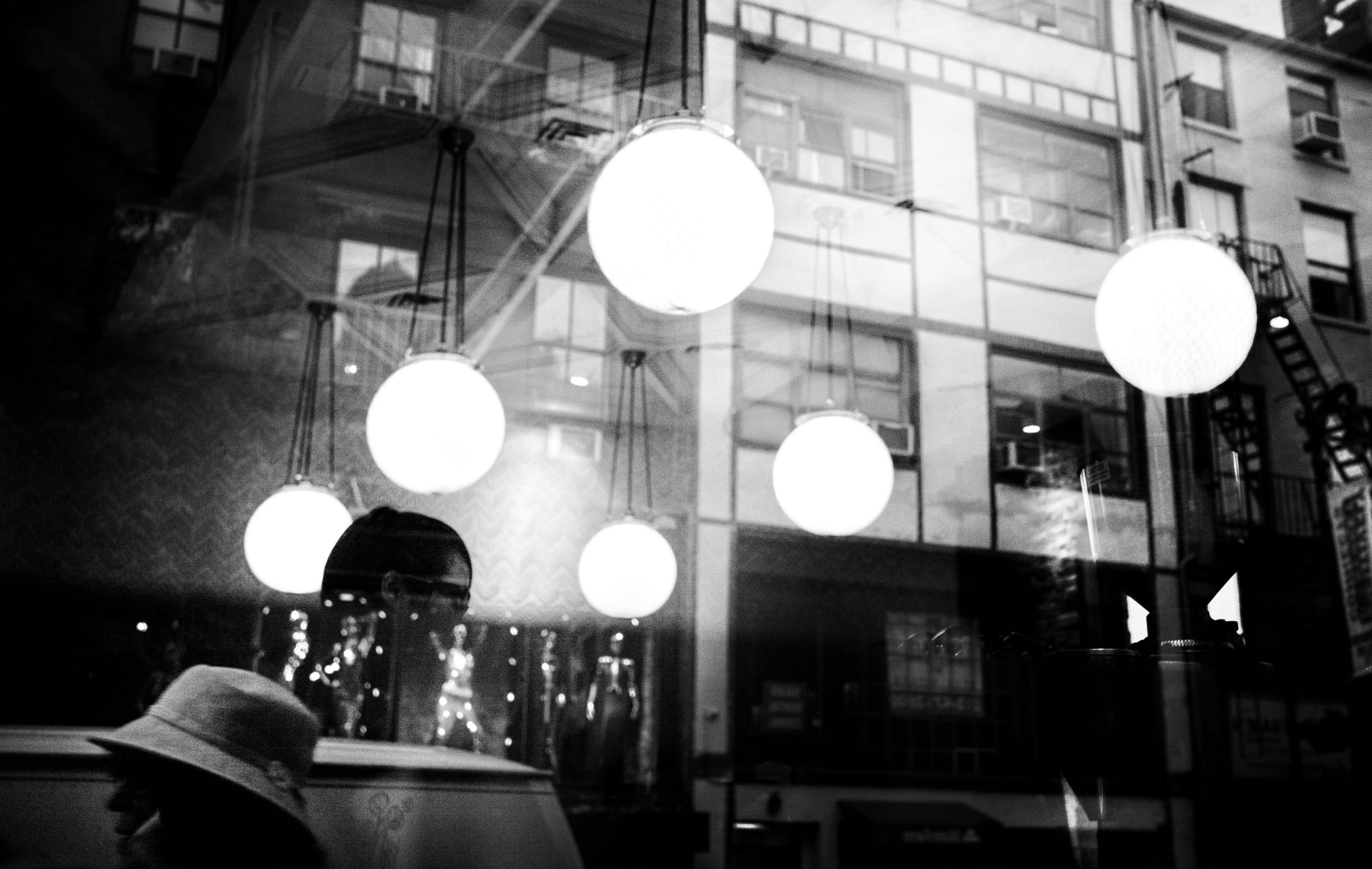
6. And most often, reflections can blend the entire scene to create a juxtaposition of elements, forms and shapes that can be poetic, strange, out of this world. In this example above, the big round lights in the shop are juxtaposed to the geometric shapes of the buildings reflected, almost over shadowing the humans in this image. The result is chaotic, impression over impression, confusion and collision of elements, a world where the real and the reflected cannot be pulled apart anymore.

The Strange and Unfamiliar - Part 4

What is Strangeness? A sense of otherness. The opposite of common, ordinary, familiar. Strangeness comes out of capturing human beings and the world in a different, unfamiliar light. In this article, I wanted to explore different ways I have evoked a sense of strangeness and otherness in my photography - and through this, introduce possible avenues for you to explore. I hope you will enjoy this reading, and if so, let me know in the comments!

While there are many ways to think of the strange and unfamiliar, in my next series of articles I will discuss five themes that are close to my heart:

  1. Transforming the relationship between man and the city

  2. Introducing shadows as a destabilizing element

  3. Connecting elements to create tension and parallels

  4. Windows to create distance and a sense of otherness

  5. Using reflections to fully transform the reality


4. Windows to create distance and a sense of otherness

Though windows, we are forever outsiders, observing a private world that we are not part of, and that we can never truly comprehend. This sense of otherness, of distance between ourselves and the subject, and of unknowability, is a common consequence of shooting people across windows of any kind. They may see us or look away, they may be absorbed in a conversation or be asleep in front of us, the mystery accompanying these images is forever endless. So much is hidden from us, shielded from our eyes, that we cannot completely grasp this other reality. In essence, through observing life through windows, we are establishing a barrier that we will never truly overcome, and we create images that evoke another world filled with people who remain out of reach, unknowable to us, and perhaps even to themselves.

4.1 This image of an older man looking through the window of a moving bus conveys a sense of otherness, of longings that can never be shared. He’s looking in the direction of the camera, but not quite at the camera - he’s looking in the void, captured in his own thoughts, and his sad, pensive gaze creates a sense of isolation. Isolation in the space of an empty bus, but also in our cognitive space. We are looking at a man that we cannot reach, the window acting as a definitive layer of separation between him and the viewer. There’s an atmosphere of sadness from the rain and night all around us, and we are left wondering where this man is going, and what goes on his mind. The window here gives a brief moment of connection with someone we will never truly know, and at the same time, creates distance and differentiation between him and us. While there is familiarity in this scene, this man looking at us without seeing us emphasizes how little we know about people.

4.2 This image of a little girl could be interesting on its own, for the light and contrast in the image, and the perpendicular lines created by the frame of the door. But there is more to it, when we start to see the man behind, or part of a man behind, overlooking that little girl. Because we can’t see him fully, his features add a layer of mystery and unknown. His relationship with the girl, for example, is not clear. Is he protecting her, or is he an unfamiliar, potentially menacing presence in the background? The window here acts as a divisor between us and them, and we are left with a slight discomfort not knowing who this man is, and what he represents - either protection or menace, familiarity or unfamiliarity. What happens behind the door will remain out of sight forever.

4.3 Indeed, windows separate and hide who’s really behind, creating a sense of otherness and distantiation. In this image, there is much left to the imagination, to the world of strange and unfamiliar. All we can see through the window is a hand, lost among the many reflections of the city. This hand has a wedding ring, clearly. But what this hand is doing here, and who it belongs to will never be shared nor seen. The window offers a stance into the private life of people, and yet hides most of this life from us - literally and figuratively. And due to the reflections, we are not able to place this hand in the context of human habitation - the reflected windows all around us dominate and shield our subject entirely, leaving the mystery of this ‘other’ man, completely intact.

4.4 Windows as an element creating distance and otherness can also work with other materials, or ‘barriers’ between us and the subject(s). Here, a transparent umbrella creates an opportunity to observe without being seen, but at the same time, gives us an incomplete and distorted vision of the world beyond. Our subject, this blond woman, appears out of reach, blurred into the layers of the umbrella, while other people in the forefront and background of the image only have bodies that we can glimpse at, no faces or heads. This creates the effect of observing an incomplete and unfamiliar world, a world mirroring ours and yet, out of reach, and mostly out of sight. Being so close, we are forever separated from them, forever left to ponder about a reality that seems familiar and strange all at the same time.

4.5 The consequence of looking through a closed window is to observe from the outside. Being the outsider, we can never really fathom the world that is beyond us, and much is left to the imagination. A sense of strangeness, while utterly possible outdoor in the street, is somehow amplified through a window or a glass. It gives the false impression of proximity, while shielding us from what’s really happening inside - creating a distance that we can never truly overcome. In this image, we observe someone sleeping or dreaming, in the middle of a busy coffee shop. There is strong contrast between the private act of sleeping, even temporarily, and the public act of consuming a coffee with others in a shop, which creates a sense of strangeness in this image. Perhaps our subject is just resting, alert to what’s happening around her (but not aware of us), or perhaps she’s actually sleeping, lost in her dreams. This ambiguity is made possible because of our position as an outsider beyond the glass shielding her, making her forever mysterious and inaccesible to us.

4.6 When there is a direct connection with the viewer through eye contact, like in this photograph above, the window as a divisor can create an unsettling feeling, of seeing and being seen, while never really comprehending what’s happening behind the glass. This image is mysterious at the very least, the woman lost in the reflections of the city, alarmingly beautiful and somewhat floating in the space. But her gaze is strong, almost disdainful. The juxtaposition of all of these layers combined with her response to the photograph is somewhat unsettling - from invisible, we’ve become utterly visible, and yet, much of her mystery is preserved with this glass separating her from us. Where is she? What is she doing? What’s going on behind her? None of this is accessible to us. She belongs to another world that we cannot reach.


Thank you for reading, and I wish you a lovely day and happy pursuit in your street photography journey. Stay tuned for our last chapter - Part 5: The transformative power of reflections to distort reality.

The Strange and Unfamiliar - Part 3

What is Strangeness? A sense of otherness. The opposite of common, ordinary, familiar. Strangeness comes out of capturing human beings and the world in a different, unfamiliar light. In this article, I wanted to explore different ways I have evoked a sense of strangeness and otherness in my photography - and through this, introduce possible avenues for you to explore. I hope you will enjoy this reading, and if so, let me know in the comments!

While there are many ways to think of the strange and unfamiliar, in my next series of articles I will discuss five themes that are close to my heart:

  1. Transforming the relationship between man and the city

  2. Introducing shadows as a destabilizing element

  3. Connecting elements to create tension and parallels

  4. Windows to create distance and a sense of otherness

  5. Using reflections to fully transform the reality


Part 3 - Connecting elements to create tension and parallels

Sometimes, this is simply the interactions between elements in a photograph that create strange, uncanny scenes, creating illusions and playfully deceiving the viewer. Objects can take a disproportionate importance, creating abstract, uncanny or absurd worlds. Subjects themselves can be connected in weird and unrealistic ways to create new meaning and feelings. There are many possible avenues to create strangeness through juxtaposing elements in a photograph, in a way that creates tension and / or ambiguity, and often through invisible lines creating connections and meaning in the photograph, between objects and subjects. Below are a few examples from my own portfolio to illustrate this theme.

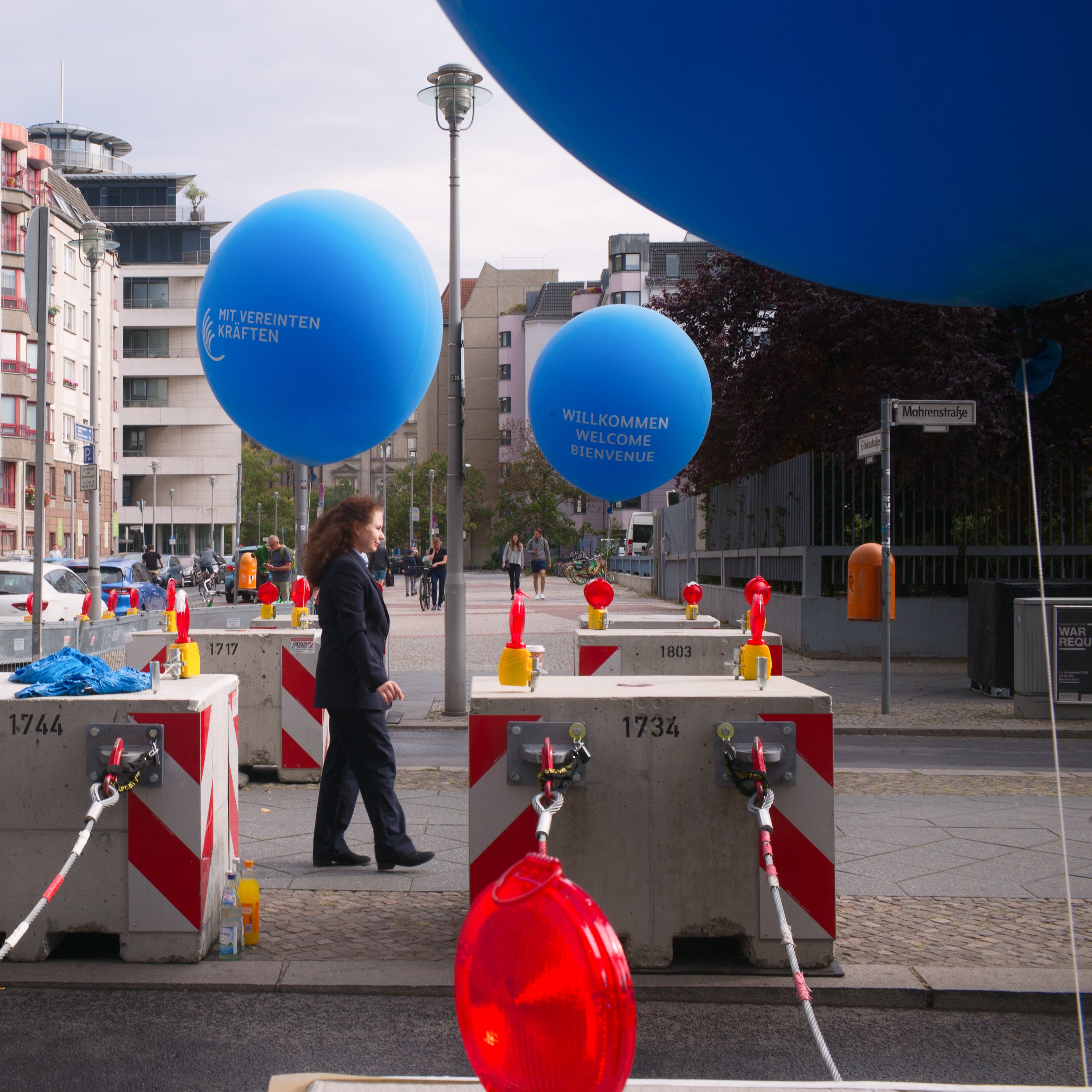
1. In this image, the collision of red and blue objects surrounding the subject creates interest in a suddenly unfamiliar scene. We’ve all seen road blocks and balloons, but here is this is the composition itself that connects all those elements together and somehow achieves to elevate a mundane story to something strange, uncommon. The blue ballon in the top right corner is so predominant in the frame that our mind starts to connect elements where there should be no connection in reality. The subject emerges in a world of rounded blue and red shapes, surrounded on all sides, as if she’d be added as an after-thought to an abstract image. Her humanity here is lost in chaotic geometry.

2. In this image above, the strangeness comes from an illusion of size and proximity. The giant legs appear closer to the boy than they really are, and are moving in the opposite direction - creating a strange impression that the boy is soon going to be trapped by these giant legs. The image frames our subject very clearly, taking a bended shape as he climbs the stairs. On the other hand, we can see only the giant feet of strangers coming in his direction, seemingly close to impact with our subject. Connecting elements like this and playing with proportions can give strange, funny and uncanny scenes through our photography.

3.3. A somewhat uncanny, bizarre scene can emerge from the juxtaposition of multiple subjects who are apparently unconnected, while the dynamic of the group creates a strange impression on the viewer. In this image above, we have four subjects, all looking in different directions - creating invisible lines with their eyes and their postures. They appear to be on a shopping street, where people are normally walking. Yet they are all in a stand-still in this photograph, their eyes never crossing each other, seemingly unaware of the others but for the last man in the background observing the entire scene. The light also plays an important role in creating areas of shadows and emphasizing the strange dynamic of all these different bodies turned at different angles, looking beyond their shoulders, up their nose, away where we cannot see. The resulting effect is that of a strange dance of strangers, and our eyes do not know what to believe.

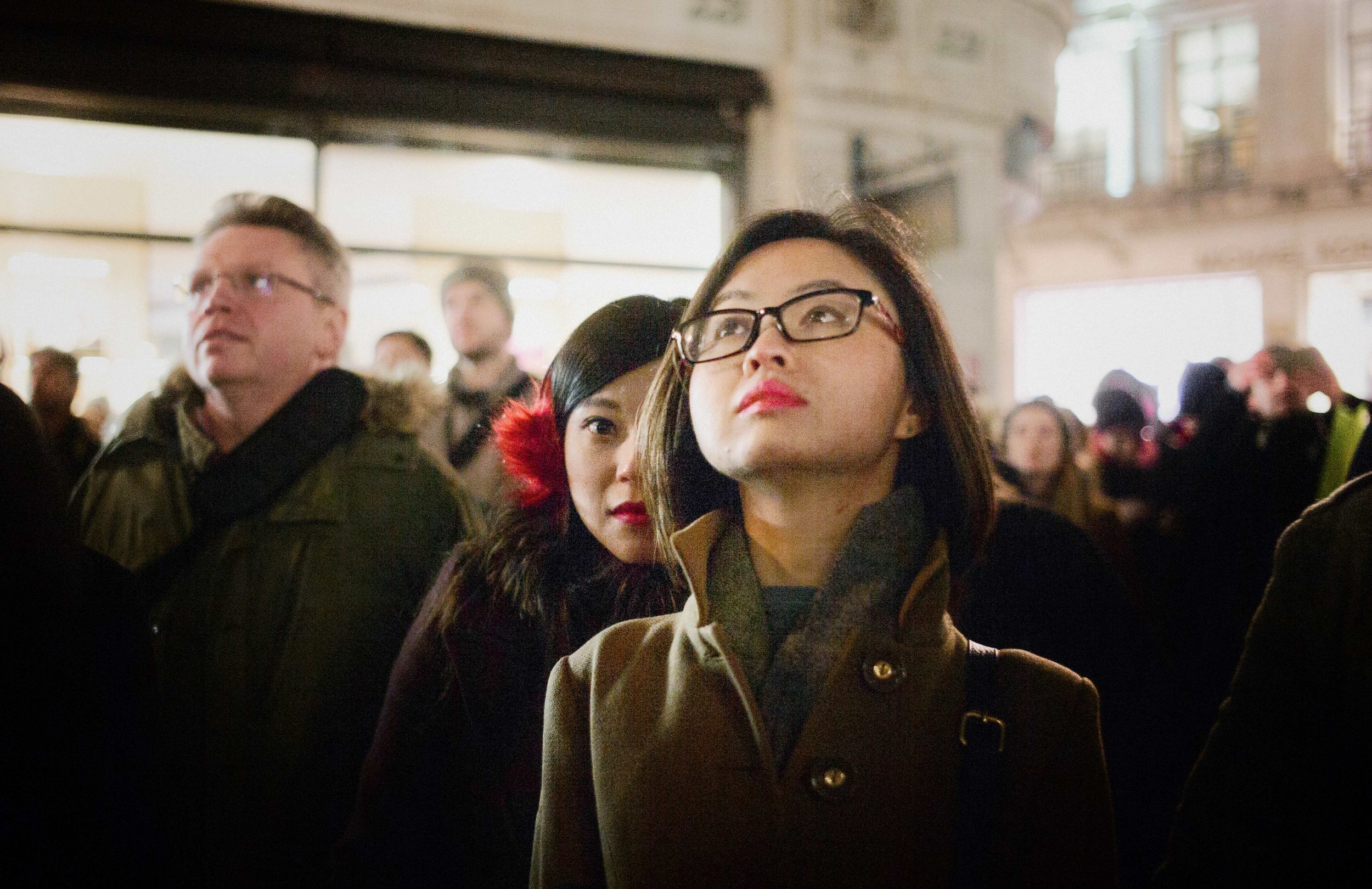
3.4 And sometimes, the uncanny can emerge from a direct connection with the photographer, and by extension, the viewer. In this scene, what creates interest is not simply the second subject looking directly in the eyes of the camera, becoming aware of the intrusion. It is the surrounding subjects in the crowd, all unaware of the camera, all looking away in the same direction, as opposed to this woman seeing through us, escaping from the crowd itself to become an active mirror of who we are. It’s also noticeable that she’s hiding behind the woman in the front, only partially visible to us, while her friend in the front remains perfectly unaware of our presence on the scene - which creates tension in the image. We are left to wonder who she is, what her connection with the woman in the front is, and what she thinks of us. This double reflection creates a sense of otherness, of separation, between them and us.

The dog leash

3.5 In this image on the left, the sense of strangeness comes from an illusion: the small woman in the background appears as if whe was holding the dog leash herself, or at least part of it - which is not physically possible. In doing so, this image creates a sense of tension, connecting directly two elements that are, in fact, on different planes in the image. This additional connection is what creates a strange, uncanny image.

3.6 And finally, to close this series of examples, here’s an old image I took in Chicago, from a lower perspective. Here the strangeness and absurdity comes from juxtaposing the fence with human bodies, so that each body is visible through the fence, yet their heads are hidden - depriving them of an important element of their humanity and identity. The perspective and angle in this photograph are everything. Too high or too low, and you wouldn’t get the same results, while the near perfect alignment of bodies over the holes of the fence shaped like bodies themselves creates this uncanny, unfamiliar and strange effect.


That’s all for today. Stay tuned for Part 4 and 5 of this blog series, coming soon! I wish you well in your photographic journey. To the next episode :)