blog posts

street photography tips, london street photography, london photography

Part 1 | Elements of creativity: The environment

This blog post is the second of a series on creativity in street photography, which will later become my next ebook! Through the lens of 8 contemporary street photographers, we will explore in this article the workings of our creativity –  decoding a mysterious process as unique as the artists interviewed here. David Carol, Rammy Narula, Rohit Vohra, Mike Lee, Melissa Breyer, Martin Waltz, Nima Taradji and Arek Rataj – You’ve inspired me. Thank you!

Based on these interviews, I have identified 3 fundamental elements to creativity. Each of these elements influences image-making and creativity for street photographers. This first post is about the external world that I define as: The people, places and situations that we come across on the streets – the external stage, as it appears to us.


Introduction

Street photographers have a fascination for the outside world which they perceive intuitively. Many have a strong attachment to places, associated with different approaches. In this first section, we will explore the role of the external environment in the image-making process, notably understanding the importance of places and locations in defining the set of opportunities.  For street photographers, the outside world is ultimately their stage: this is the place where images come to being, and realize themselves in front of our eyes.  In this sense, images would never exist without a world outside of ourselves, a world filled with people and cities that tell interconnected stories. The world, in essence, is our greatest source of inspiration – life is the raw material, as Martin U. Waltz beautifully explained, and we are the gatherer of this raw material. Without it, our art wouldn’t exist.

Images by Mike Lee

Key insights

1. The importance of cities. For street photographers, cities oftentimes are as important as the people inhabiting them. Cities have a soul of their own, that many photographers will aim to capture. In fact, the individual stories of people that we shoot doesn’t interest us as much – they will remain strangers whom we will never see again, and probably never speak to.  Cities are perceived as a limitless source of inspiration for street photographers, never fully knowable, always changing, a stage where stories happen magically – right in front of us, in the most unexpected settings.

2. Intimate relationship to places.  Many street photographers have an intimate understanding of their cities and neighborhoods. They repeatedly come back over and over again to the same places, the same streets, neighborhoods, to whom they attach particular feelings and expectations. For example, crowded places will lend themselves to much closer and personal images, whereas architectural areas will spark ideas for minimalist photography.

But it’s also the belief that through developing a unique relationship with places, we can start to see differently – beyond the common and the obvious. To tell certain stories, it’s easier to come back over and over again to the same places that we have grown to know intimately.

3. An intuitive understanding. Street photographers display an instinctive and intuitive understanding of their surroundings – whether familiar or unfamiliar to them. In fact, many of them can’t say for sure why they took a specific shot, and how they’ve come to take this shot, as so much of this process comes naturally to them.  Yet intuition as magical as it seems, can be nurtured through continuous analysis and exploration of one’s and other’s work.  This intuitive understanding of their surroundings allow them to see stories beyond the reality of a single subject. As HCB explained in The Decisive Moment, this intuitive quality is fundamental in perceiving the realization of an event happening in the external world, and the simultaneous orchestration of forms able to tell this event. Yet oftentimes, this event finds itself at the intersection of people and the city.

4. Of coincidences and serendipity. As importantly perhaps, street photographers believe in the power of coincidences, and in the principle of serendipity - being there at the right time, at the right place to capture a unique moment.  Their approach to capturing the external world is in essence filled with mindfulness.  Like Rammy Narula said, being a street photographer is belonging to the moment. This is why street photographers never plan – not planning and letting themselves be surprised is a huge part of the joy they take from the experience. If they were to plan or stick to an idea, they would miss great opportunities happening around them.  Of course, a certain level of pre-determination is somewhat inevitable. While we don’t plan, the weather, moods and light will all influence what we shoot. After years and years of practice, we know how to maximise the opportunity during grey days for example. This doesn’t mean that we have anticipated everything, but our mind and eyes might be searching for subtle hues and layers that sunny days will not provide.

5. Candid images, subjective POV. When it comes to shooting and framing, street photographers are extremely attached to the idea that they are shooting candid, non-staged captures of people in the street. They have a desire to remain true to the scene they are seeing, with its imperfections and chaotic elements. In this sense, they consider their images to be documentary in nature (i.e. not manipulating what the photographer sees at any moment in time). In reality however, street photographers are not bound by telling the truth with an objective point of view. Their choices of composition, angles, distance and focus will all ultimately create the story, much more so than the subject alone. We could also argue that certain types of shots, such as humans in architectural settings, illustrate a form of “calculated candidness” where composition is more deliberate and precise, and the “moment” is in fact a succession of possible moments.

Case study: Mike Lee

Mike Lee doesn’t reflect on what he does: his mind is always searching for the next shot. He trusts his instincts to lead him the way.  Mike shoots from 8 to 10am every day, on his way to work, capturing the lively and rushing morning life of NYC. His work is at times blurred and angled, and reflects his obsession of capturing the story in front of him– much more so than capturing it technically, which is only his second priority. Mike Lee never plans, it’s part of the joy he takes from the experience. He remains conscious of his surroundings and is a keen observer of the world around him. In fact, he started street photography to become more aware of the city and the people, outside of his world centered on his child. His images reflect an intuitive understanding of his surroundings, but equally a desire to seize and embrace this world through photography: “You run to and embrace the world – it doesn’t come to you”.


Case study: Arek Rataj

Arek Rataj has a special interest in what he calls “situational photography”, a larger umbrella of terms inclusive of candid, unplanned, un-staged photography – whether on the street or not. Immensely obsessed with faces and micro-expressions, Arek fully believes in the principle of serendipity.  His quest so far has been to reveal to the outside world these truthful expressions that come to being in front of his eyes. While his photography is inherently more about subjects and faces than the city itself, all elements within the image corroborate to create strange, intimate portraits of strangers with a darker, sometimes sinister mood. Once he has identified an interesting subject, his focus turns to understanding how to approach the subject, how to frame technically, and how to remain invisible all the while to capture a unique moment.


Conclusion

  • The city is the street photographer’s real stage – images happen in front of them, not when they try to control them.
  • The city is nearly as important as the people themselves. Combining elements together allow stories to be created.
  • Street photographers believe in the concept of serendipity and coincidence, taking a mindful approach on the street.
  • They have a particular attachment to places that they know very well, having formed an intimate relationships with them.
  • Their style and comprehension of their surroundings is highly instinctive and intuitive at all time.
  • They nearly never plan their shots in advance, yet are influenced by factors like weather and light.
  • They thrive to take candid photographs, but not to emulate the truth – their POV is subjective.

Image by Arek Rataj
Podcasts with Valerie Jardin on Hits the Streets

It's been quite a long time that I have not been able to post on my blog - but since then, a lot has been going on on my side. For instance, I wanted to point you out to two fun podcasts that we did recently with Valerie Jardin, on her new Hits the Streets channel.

The first one is a Q&A session where Valerie and I answered some of your witty questions :) You can find this episode here.

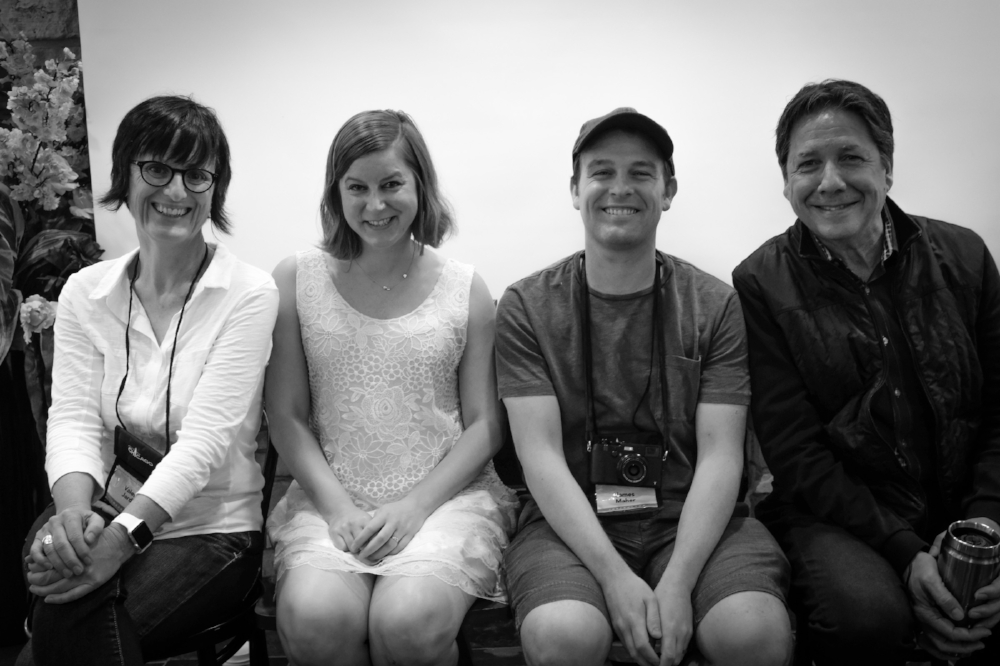
The second one was a street photography panel organised by the Out of Chicago Conference, with Valerie, James Maher, Steve Simon and I. Be ready to listen for one hour and a half of debates over what matters most in street photography! You can find the episode here.

Hope you'll enjoy!

Marie

Free eBook: Storytelling in street photography

free eBook

Understanding storytelling in street photography to create deeper, more meaningful images that convey strong emotions.

HI everyone,

It's been two years now that I first published my free eBook: Creating Impact | Fundamentals of storytelling in street photography. It's now been read by over 100,000 people throughout the world, which is much more than this little book deserves :)

So far, the book was published on Issuu, a great publishing platform. But given that direct download options have been removed, or have been so hidden as to make them impossible to find, I decided to set up a direct download link to make it easier to access. After all, it's a book, it shouldn't live purely in the cloud :)

So if you have time, and desire so, you can now download this ebook for free. I hope that it will be as useful to you as it was for for me in guiding you through your photographic journey.

Let me know what you think, and have a lovely week end,

Marie

From capturing the unexpected to anticipating stories

Capturing the moment in street photography requires a delicate balance of intuition and intent. Depending on who you are, you may prefer to use one over the other, and this will undoubtedly impact your style and your photography. At a very basic level, some photographers feel more comfortable finding an appropriate frame to let stories happen, while some are happy to capture images on the go, without pre-defined ideas and nearly no thinking at all. But exploring techniques where we feel less comfortable may just be the right way to take our street photography skills to the next level – and uncover a whole new world of possibilities for our creativity and photography.

When thinking of shooting styles, we can define three distinct methods for capturing the moment based on level of intent:

  • Premeditation – Determining beforehand the scene and possible story in a static frame, and waiting for subjects to create the envisioned story.
  • Anticipation – Anticipating what the story could be in a dynamic, shifting environment, and working the scene intelligently to capture these stories.
  • Awareness – Capturing unexpected stories and encounters on the go, as they reveal themselves, in a moment-by-moment awareness.


Premeditation

Premeditation is akin to staging without actors. This first scenario happens when a photographer finds an interesting backdrop and visualizes in his or her mind the image that could be made out of it. It then becomes a simple game of waiting for the ultimate actor(s) – this one unknown person(s) that will bring to life the backdrop through creating interesting patterns, shadow plays, or juxtapositions. In essence, premeditated scenes are often where we begin: it’s the first stage in achieving a minimalist image, or making the most of a static background. It can certainly lead to impactful images, yet one has to consider the time investment. While we wait and wait for the ultimate shot that we have in mind, many opportunities could go by... It’s in essence a game of patience. In my view, there are two major situations where premeditation can work and should be used:

Bringing to life captivating backgrounds

The first circumstance is obvious: the background in itself is interesting, and, combined with a human element, can create an interesting story (if certainly expected in many cases). The background you have chosen may have great architecture which will contrast with your human subject(s), or may have a unique wall art that will create interesting juxtapositions when combined with the right people. In general, many beginners will start there, placing themselves at a distance from the scene, and waiting for the right people to fill in the gap – the story is already in their mind, premeditated, ready to materialize.

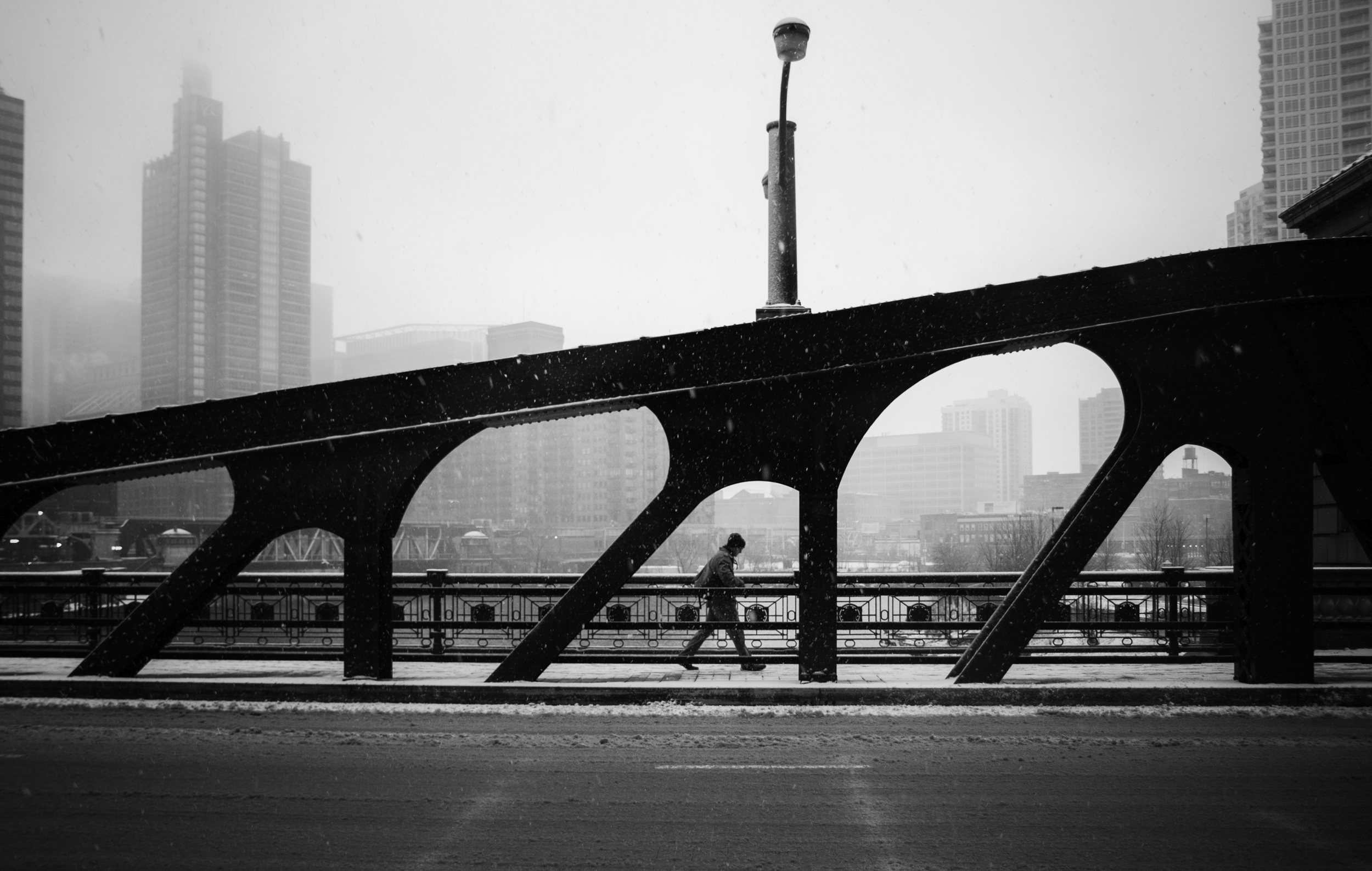
Example: I took this first image in Chicago, about three years ago, when I was starting street photography. It was terribly cold that day, so my walk was not going to last long. I went to this area of town where two magnificent bridges cross the Chicago River. As I was reaching the bridge, I immediately saw an opportunity to shoot the few people walking on the other side. I then placed myself where I believed the frame would be most impactful, and shot perhaps 2-3 shots of people. In the meantime, I knew what I wanted: a single person central to the image, connecting with the street light. Another two shots and I was done – I had captured what I had in mind in less than 10 minutes, and got in fact a better shot than I had expected, with a man stooped in the just the right way to symbolize the arc of the bridge. I would define this shot as premeditated, since the frame was defined, and my vision of the final image was already present in my mind.

Defining the frame to let the story unfold

Sometimes, the actual story may not be fully visualized or known by the photographer, but the place, position and angle are already defined to allow such a story to come to life and be captured. In other words, the photographer purposefully defines the frame and lets the story unfold on its own. Why should we restrict ourselves to a single frame, when we could multiply opportunities through looking everywhere else? Because at times, it helps us focus and center ourselves. It may be that the background provides a sense of neutrality from which human stories can be captured without distracting elements. Or it may be that the light provides unique effects on the wall across us, and on people passing by. Whatever this is that attracts your attention and stimulates your imagination, it may be wise to stop and frame if you can foresee a clear opportunity for a story.

Example: While shooting in Notting Hill, I came across this very neutral background, white and simple, with one small tree in front of it. The light was creating interesting shadows around, so I was keen to leverage this space for a few shots. There was a man standing there, right at the intersection between shadows, and he was in himself an interesting subject. However, to create a more dynamic story, I simply waited one minute or two for additional actors to come within the frame. The goal was then to capture the best story given the foundational elements: a man standing on his own, and a set of overwhelming shadows creating a surrealist scene. While I would categorize this shot as premeditated, there is a strong element of intuition required to make these stories happen, since we cannot fully anticipate them or visualize them beforehand. It all depends on what will emerge within the boundaries of the frame.

To successfully take premeditated shots, one has to consider all the parameters of a scene. Working the scene to find the perfect point of view is essential to ensure maximum impact. It also requires imagination: what can this scene become? What images could be striking? And what are the implications on the angle, position and distance? Visualizing the frame in one’s mind is the key – the scene is the set, and you are the director. You just need to make the most of the show at hand.


Anticipation

Anticipation is a game of possibilities within a defined, multi-dimensional scene. Because life itself is never static, we will most likely never predict all opportunities potentially emerging in front of us. But we can anticipate some of the stories beforehand, and work the scene until these stories (or others) materialize themselves. Contrary to pure premeditation, the art of anticipation requires to think within environments that are dynamic and constantly shifting, and where the number of possibilities are nearly infinite. What then can we anticipate, and how can we do this? The first step is to define a potential scene/focus. You could be in a park, for example. You could be standing at a street corner, looking in multiple directions. You could even be watching a game played by kids on the street. Whatever this is, in order to anticipate stories successfully, you first need to define the boundaries of the scene that you will consciously work out. It then becomes a game of scanning the environment around you, testing new angles, looking up and down, taking a step back, or a step nearer. This technique is difficult because it requires a good dose of imagination and thinking, while being able to trust your intuition when the time comes to shoot.  But with higher difficulty comes higher rewards, so let’s discuss this technique in more details.

Defining a multi-dimensional scene

As discussed earlier, a great way to use anticipation is to define a limited space where to operate. Think of a space that you can explore whether through walking around, or through standing still looking in multiple directions. This is your set, your multi-dimensional scene. While anything can happen, you will soon realize that you can, in fact, anticipate interesting stories and work your way to materialize these stories. In a confined, limited space, you can start envisioning your story. Light may play an important role, and stories of light & shadows will become predominant. Or you may identify patterns in people’s behaviors in this place – perhaps the way they walk across different layers create interesting scenes to capture, if you are patient enough for all the elements to come together. So the first step is to define boundaries and analyze the area for potential stories.

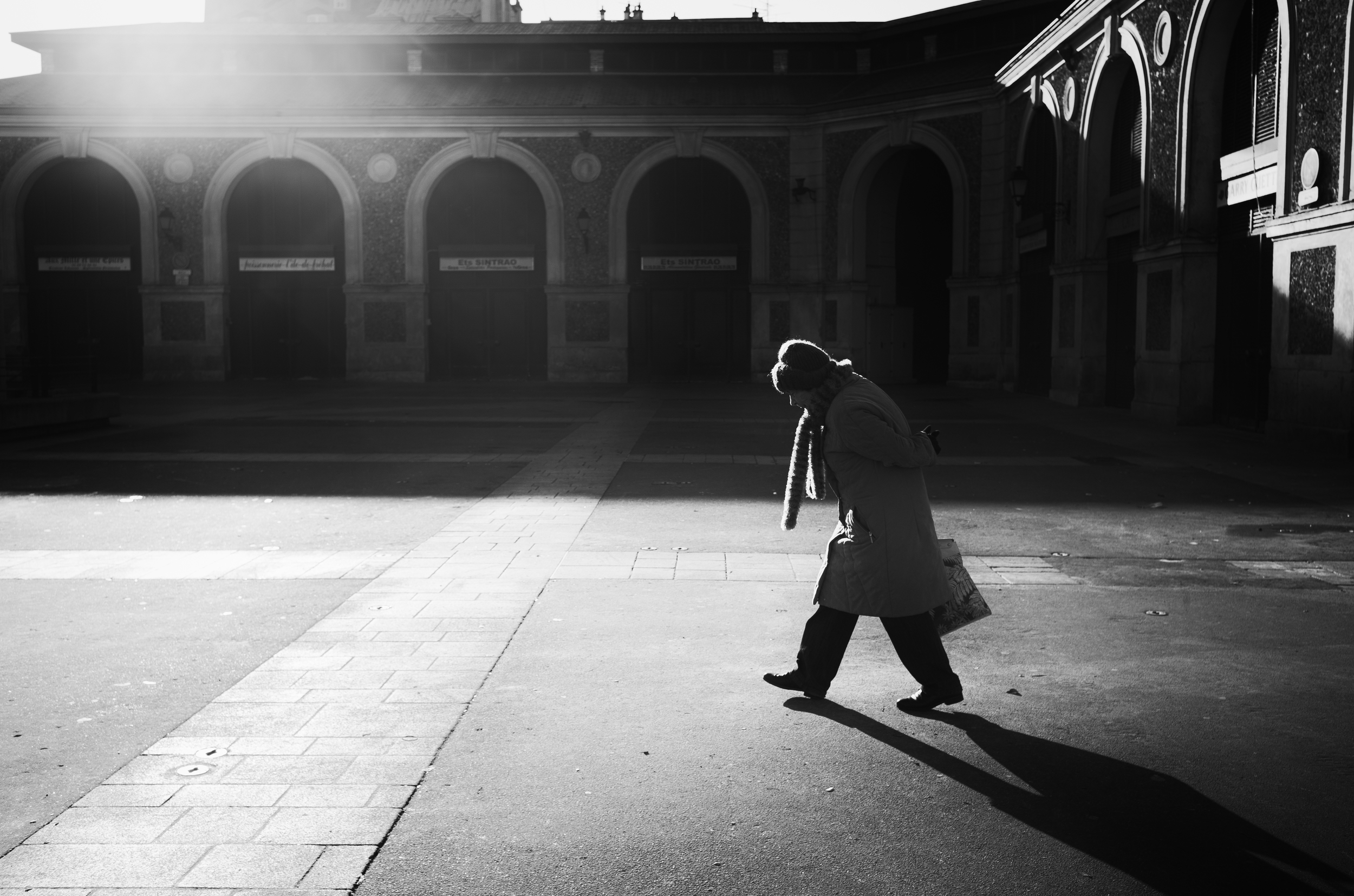
Example: While shooting in Versailles (a city close to Paris), I came across this old market, surrounded by arcades. The place is empty apart from the week-ends where shops are being set up. The area forms a square, crossed by four roads on each side. I started first to explore the area, and identify the play of lights on the building and the people. I looked carefully at the people coming by, who they were, where they were headed – trying to narrow down the scope of possible stories to be better prepared. I realized that many passer-by were by themselves, usually crossing very fast as the air was very cold. That’s how I started to anticipate and visualize the type of stories that could happen, right now, and right there. It was only natural then to capture this old lady as she passed by me, giving me a great image to take back.

Working the scene to anticipate further stories

For most places, however, it can be harder to anticipate stories on the spot. You will need to look further, go beyond the obvious, and find a more specific angle for your story (literally and non-literally!). How you work the scene will determine whether you can successfully anticipate the next best story to come. This is very simple: ideas come as you move around, discover new angles, and identify new possibilities. It’s often the case of a missed opportunity (either a shot you failed to take, or an idea that failed to materialize) that will give you the inspiration for your next best shot. In essence, anticipation requires curiosity, and the drive to explore the world around you. The more aware you become of the possibilities, the better your mind can anticipate the next big moment when all elements will come together.

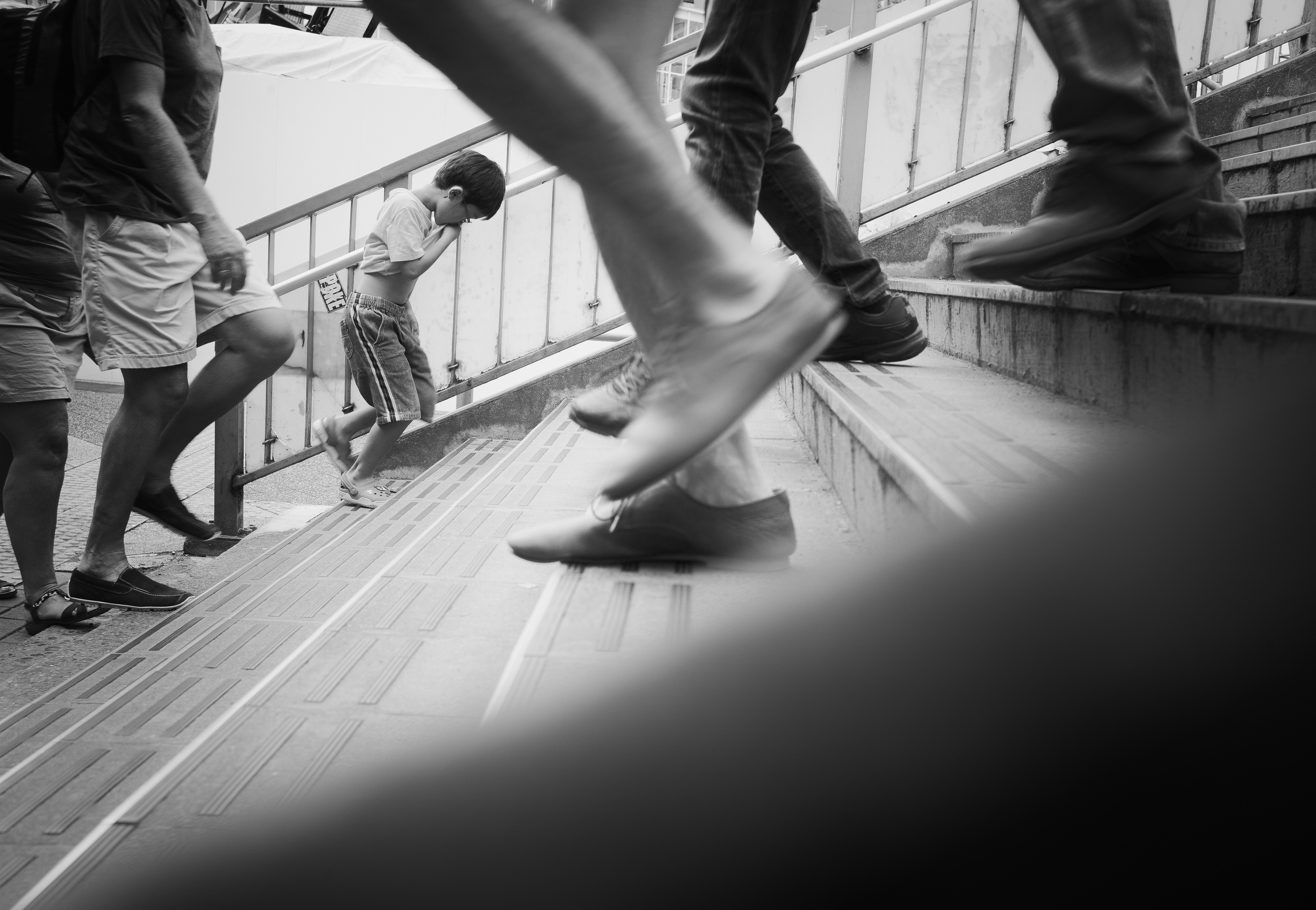
Example: While shooting in Japan, I was fascinated by the sheer number of people walking in every direction – a massive crowd of human beings moving from one place to another, from one platform to another, from one sidewalk to another. At the exit of a train station, I started shooting people going up the platform, from several angles. But this was never right – my idea of a powerful crowd was never coming to life. So I turned around and explored, and came to this particular vantage point where I could see people’s feet moving up and down. I didn’t know what would happen there, but I sensed that it was a vantage point that could give me some new possibilities, so I stayed a little while. And when the little boy came into the picture, I shot. And that was it. I had created a story from scratch.

So to summarize: In order to successfully anticipate stories, you need three elements: 1. Geographical boundaries defining the limits of the scene that you will explore, 2. An initial analysis of what stories this scene can give to you, 3. A deeper exploration of the area to stimulate your imagination and bring to life potential stories. And remember: shooting styles are infinite in themselves. Some photographers will actively walk around to understand and form an idea in their mind, while others will decide to stay still – not going after the story, but letting the story come to them, from multiple directions. Both techniques can work, as long as you think hard enough about the possibilities that may emerge in front of you.


Awareness

Premeditation and anticipation are great techniques in street photography, and will definitely yield some impactful images. However, in practice, thinking/intent is not always possible. Many shots appear in front of us unexpected, and almost unwanted. At these moments, this is our intuition (or our instinct in other words) that takes over our thinking. It’s no longer a matter of intent and purpose – it is a leap of faith in ourselves, in the world, and in the unknown. Awareness is just as critically important to street photographers as any other technique, but this is probably the hardest to master because of its reliance on intuition. I am sure that it sometimes happens to you that you come up with an insight or a solution without knowing how. Intuition works like this – it skips normal steps, seems hard to reproduce, and feels a little magical. Yet there is nothing random or lucky about intuition. It’s just one out of two ways we capture information from the world: the first one being the most common 5 senses, and the second one being this so-called 6th sense. As everything else, intuition can be nurtured. It can grow and work faster, better, smarter for us. And it can be used to capture totally unexpected street images that are forming in front of us in less than a millisecond. Let’s look in this technique a little further.

Seizing stories and opportunities as they come

So how do you, technically, seize stories on the go? By letting go first. Letting go of your thinking, of your judgment. You need to move from doing to being – a state of mind where you can fully experience the world, as it is, in the moment. The second thing to think about is NOT to think. Just shoot – whatever the results. It doesn’t matter if it sucks, but it will make a huge difference if it happens to be at least remarkable in some ways. Try it. There is something liberating in letting oneself be surprised, and opportunities can come from every corner. This makes the game so much more interesting.

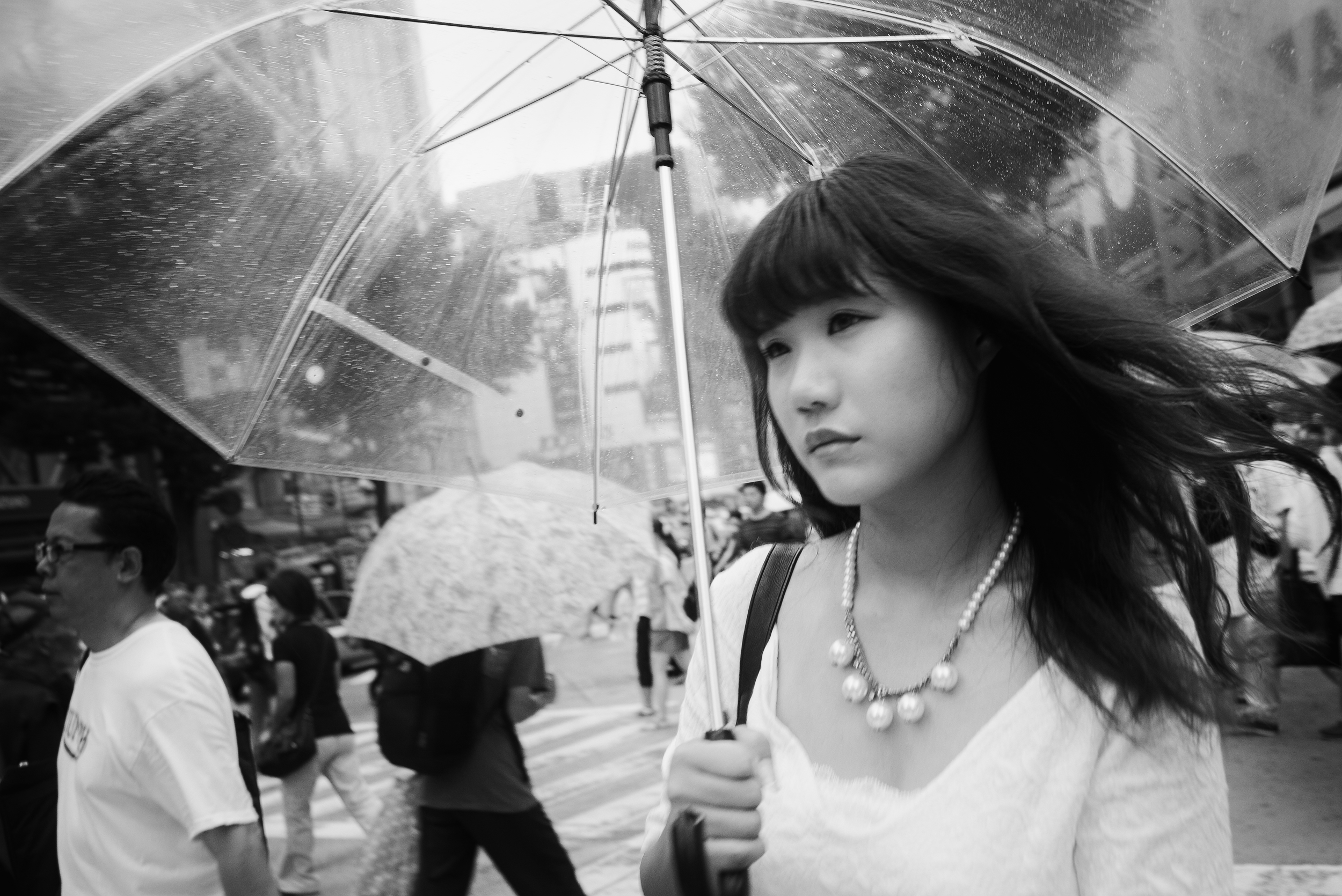
Example: One favorite shooting style of mine is to capture people as they pass by me, when I find them interesting in some ways, when their attitudes stand out, or when their expression say something. I never think too much, and I don’t often take more than one shot of a person. I constantly scan the environment as I walk pretty fast, and decide in a second whether something worthwhile is happening. With a little bit of practice, I can feel the people, the way they will turn their head, their floating hair, the expression in their eyes. And by closing my eyes I can imagine them of all kind, everywhere and nowhere, coming at me – at times surprised, angry, happy, dreaming. So when I do open my eyes, I am ready for the moment – whoever they are, I will see them and shoot at the same time, with no second thought, never questioning why. I will shoot. And we will see later.

Developing a mindful approach to street photography

Moment by moment awareness is difficult to master, this comes without saying. Yet, think about it. How many times did you make your best image when you least expected it? Probably more than you think. And the more you try, the more you’ll develop your intuition who will be doing all the work for you. No more hesitation, just purposeful mindfulness. Where to start? Choose a day where you have no defined expectation in mind. No plan. No pre-conceived idea of the shot you can get, of the scene you should work out. And get out feeling free to shoot whatever comes by – not following an agenda, but letting the world guide you. Walk here and there, do not think, do not try. Just watch around you, and practice shooting in the moment. This is as easy as that.

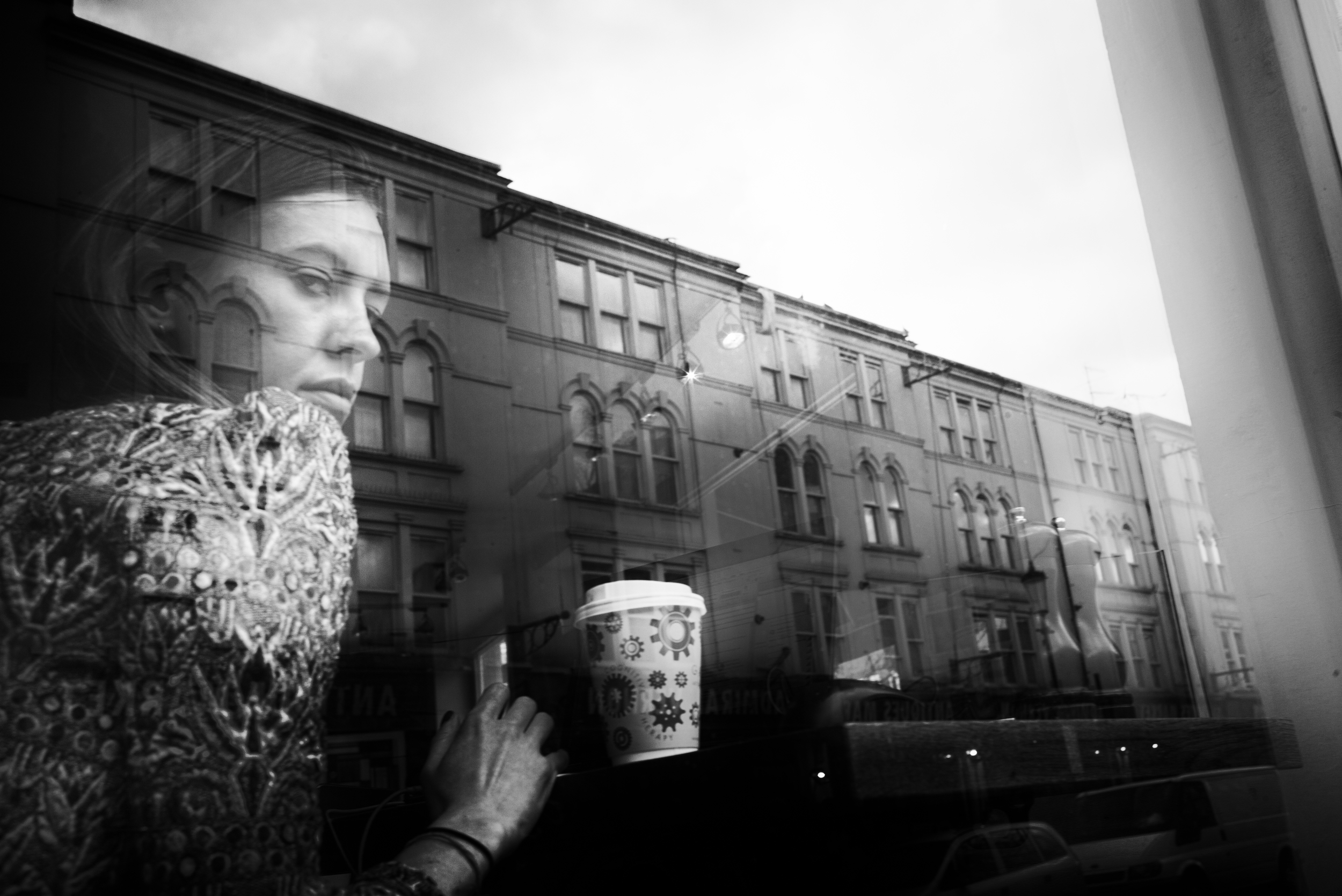
Example: This particular image was taken when the weather was grey, no light in the sky, not even interesting people around. I was following my husband across Notting Hill, but it was overall discouraging. Still, I put myself into awareness mode, and starting shooting strangers in multiple directions and angles, as they were passing by. I suddenly saw this lady, and decided to kneel down to see what the reflection could look like. At the moment I was down on my knees, she had seen me and looked back. I shot – right away. This was my only take. I was far from imagining the image that it would give in fact, I just purely followed my instinct. And I find that more and more, I need this dose of intuition to help me see beyond the visible, the planned, the expected. To help me see beyond my five senses.

In summary, awareness is akin to letting go – letting go of your hopes and fears, of what you’ve been told and what you may believe. Letting go for an instant to become part of the world and embrace opportunities as a second nature. Awareness is being, and it feels very much liberating at times, especially when too many thoughts clutter our minds, make us doubt ourselves, and deprive us of our creativity. But it is also, essentially, the way to capture the unexpected – what you cannot possibly anticipate, and yet, which will reveal itself moment by moment, anywhere and anytime.

Whatever you choose to practice, do remember that there is no one way to capture stories. So go and explore beyond your comfort zone, pushing yourself to try new techniques. You will see the results, and it may surprise you.

The editing process: balancing emotions vs. reason

I was reading an article on Winogrand by Eric Kim, and came across a quote that still startles me: “Sometimes photographers mistake emotion for what makes a great street photograph.” And by that, he means that our first emotional response when remembering a shot may not lead us to objectively assess whether the shot is good or not. He therefore advocates to wait a while (or a year in his own case) before editing and processing images, so that all memories attached to the moment would have disappeared, leaving space for clear objectivity. This advice appears to be a valuable one, at least partly. I oftentimes get attached to pictures too much, and then wonder why these pictures are not receiving the praise or attention they truly deserve. Objectively, they are probably flawed and I may start to dislike them later on. Conversely, certain images fail to move me personally, and seem to be on the verge of flatness. Yet they may receive much attention and praise, unlike some of my favorites.

And yet as time passes, my opinion – rather my affection – for my pictures never cease to be true to my initial emotional response. I tend to love certain images and dislike others. No matter how many likes they get, the ones I dislike will never end in my portfolio. Why is that?

Because, to me, the emotion I feel while taking the picture and then processing is like a deep-rooted connection to myself. It goes hand in hand with my vision. I may realize that my shot was not as good as I remember it, and will therefore not keep it. But despite my best efforts, it is hard for me to step back from my pictures and look at them objectively, analytically, out of context of my emotions – past and present. The way I see this is simple really: no matter how good a photograph is, if it isn’t fueled by some deeper emotion, I won’t learn from it and expand on it. I will not integrate it into my vision for my work. It will be a one-time shot, nearly a missed opportunity, on the verge of failure. Devoid of meaning. Out of context. To me, emotions are just this: a self-guide to assess the validity of my images versus my vision, and conform my editing/processing to the authenticity of this vision. It’s likely restraining to me, as I reject some good shots along the way, and favor more enduring versions of my inner world.  But it makes me feel alive, it makes me feel whole and consistent. It gives a voice to my intuition and does not try to explain everything.

As you probably know, I am very much in favor of analyzing one’s pictures against both form (composition) and content (subject), not only to assess the value of individual pictures, but also to understand patterns across images, explore alternatives, and learn from our mistakes and success at a global level. But analytical studies are not incompatible with emotions, far from that. In fact, I would advocate for a dual assessment at the time of editing and processing, as well as later on, in the context of your entire series:

·       Emotional and personal: Is it aligned with what you want to convey, to achieve? Does it feel right? Does it create an emotional response in you?

·       Objective and analytical: Is my composition interesting enough? Am I correctly using light? Is my subject worth of interest on its own? Does the story come across easily?

If it feels right to wait before editing your pictures, then by all means – do it! I for myself know that my memories of the moment are important enough to be incorporated in the final editing process. That something, in the city, has resonated with me, and this is this something that I want to convey through my new series. And because of this, I cannot wait. This is part of my creative process. Now, to give time the chance to work miracles out, I will never create and edit series right away. I will wait until the test of time has demonstrated whether I am 1. Still emotionally attached to the picture, and 2. Objectively assured that the picture is good enough to be included in a formal series. But the image itself will often remain as it is, same as the day it was conceived – made of emotions, good and bad, right or wrong.

At the end of the day, each one his or her own process, and assuredly, Winogrand was right about himself. His tremendous work proves it enough. You will need to figure it out on your own.

Good bye, and good luck in your photographic journey J

PS: All pictures in this series have been edited a week or two after shooting. I believe that they all reflect the feelings of the day, of the moment – the connection I felt with the city at the time, and with its inhabitants.​