blog posts

street photography tips, london street photography, london photography

The human-city relationship: Putting street portraits into context

Chapter 2 of my upcoming eBook: Understanding the human-city relationship explores the make-up of street portraits through greater integration of city elements. Getting close to people can be such a euphoric sensation. Appealing, addictive, rewarding a million times. But what makes street portraits and close ups so much interesting are not the people only – it is in fact their relationship with their surroundings: the city and the people surrounding them and giving meaning and depth to the scene. The second chapter of this book explores the human-city relationship from the perspective of human beings. How can we extend street portraits with elements from the city, evoking the fleeting essence of urban life to give deeper meaning and depth to our subjects?

Because, eventually, it is all about context. Street portraits with no context lose of their power – the candid moment is lost, the story is incomplete. Capturing the essence of strangers is at time challenging and obsessive, but the search of the perfect moment requires it. And the closer you get, the more important the city becomes in fact. So how do you transform traditional portraits into reflections of our busy, dreamy, exciting city life? How can you leverage the city – its maze of light, its trains in motion, its never-ending streets - to emphasize emotions and give substance to a portrait?


> Principle 1: Provide context
Give your subject space and context to exist beyond the limits of the frame

Context differentiates typical portraits from street portraits. Providing space to your subjects in the street, even at close distance, is essential to tell a unique story which will give substance to their personality, explain their joy or sadness. At times, using the right context will even add incremental drama – hinting at the presence of others, observers of the scene at hand. While street portraits are highly subjective because of the short distance between subject and photographer, the context will make it personal – helping the identification with not only the character, but the human story at play.

Compose your images to anchor your subjects in city life
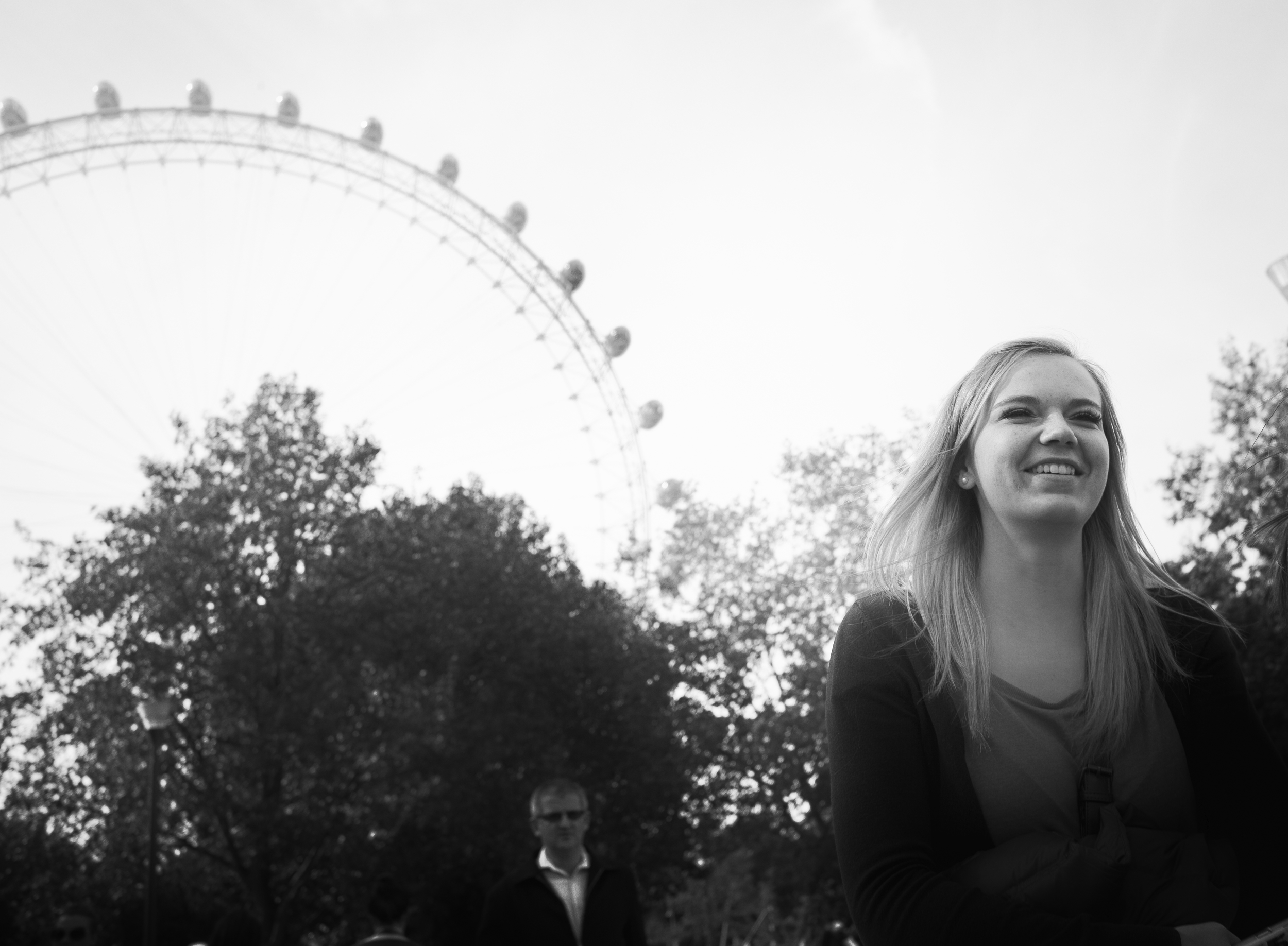
Sometimes, the simplest step in adding context to your image is to take a step back to include recognizable city elements as part of the frame. The greater the relationship between these elements and your subject, the better your story will be. In this image, I added the London Eye behind my subject on purpose, as I wanted to give her smile and overall joyful personality some context. It results in a simple image where the city itself reflects her joy and smiling face, as we often associate wheels with happy moments.

Provide enough space for emotions to expand and travel

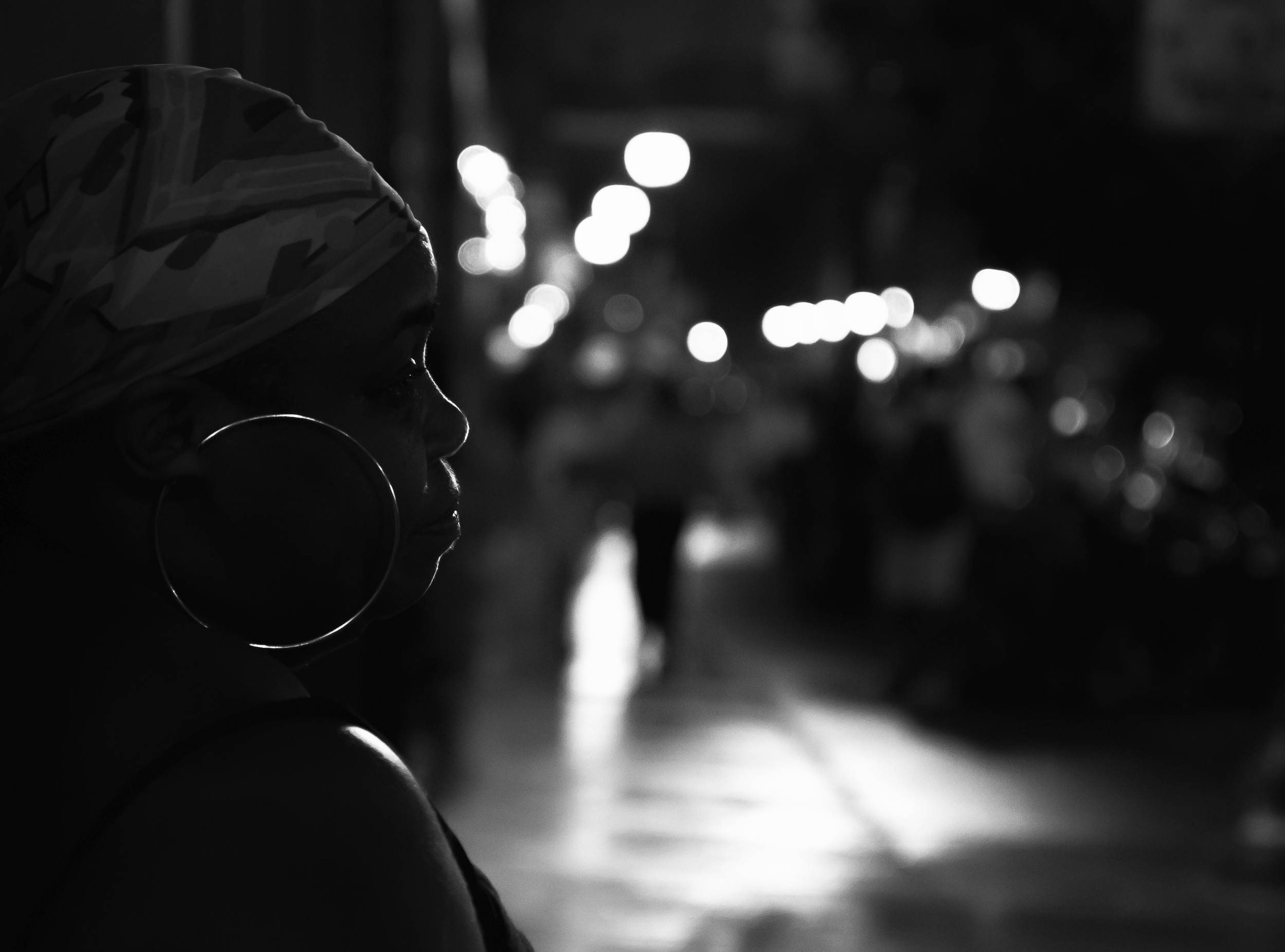
Even at very close distance, like in this image on the left, context is important. It is easy to go directly to the face of your subject, shooting, and forgetting what’s around. But eventually, your image is a whole, and the whole is stronger than the sum of its pieces. The profile of the woman in the dark, quiet and sad, is emphasized by the light and the blurry silhouette of someone at large. The frame provides space for her sadness to expand and exist, and the lights in the night reinforce my story ten times – providing enough context for emotions to travel.

Leverage background and city context to create new drama
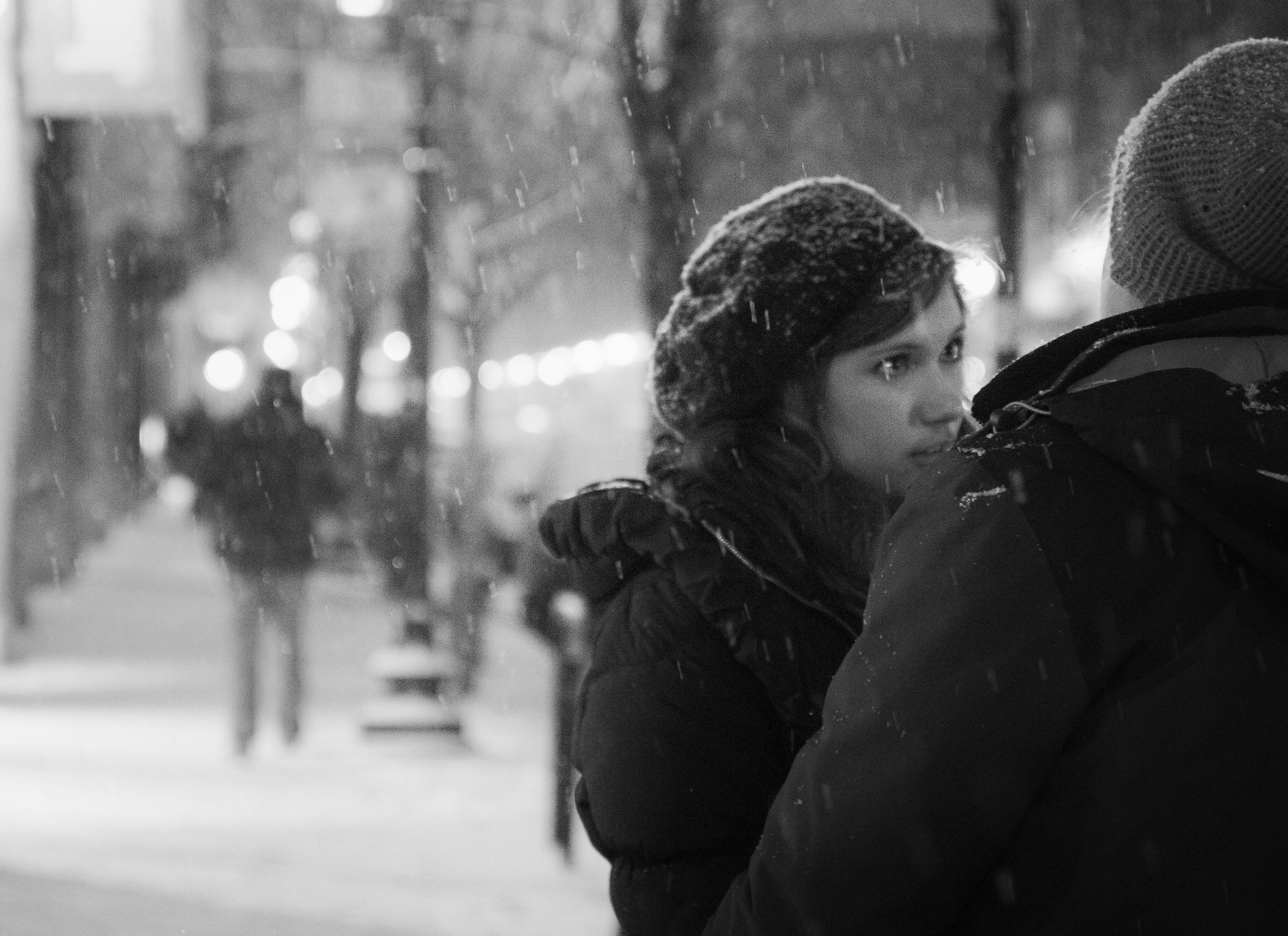
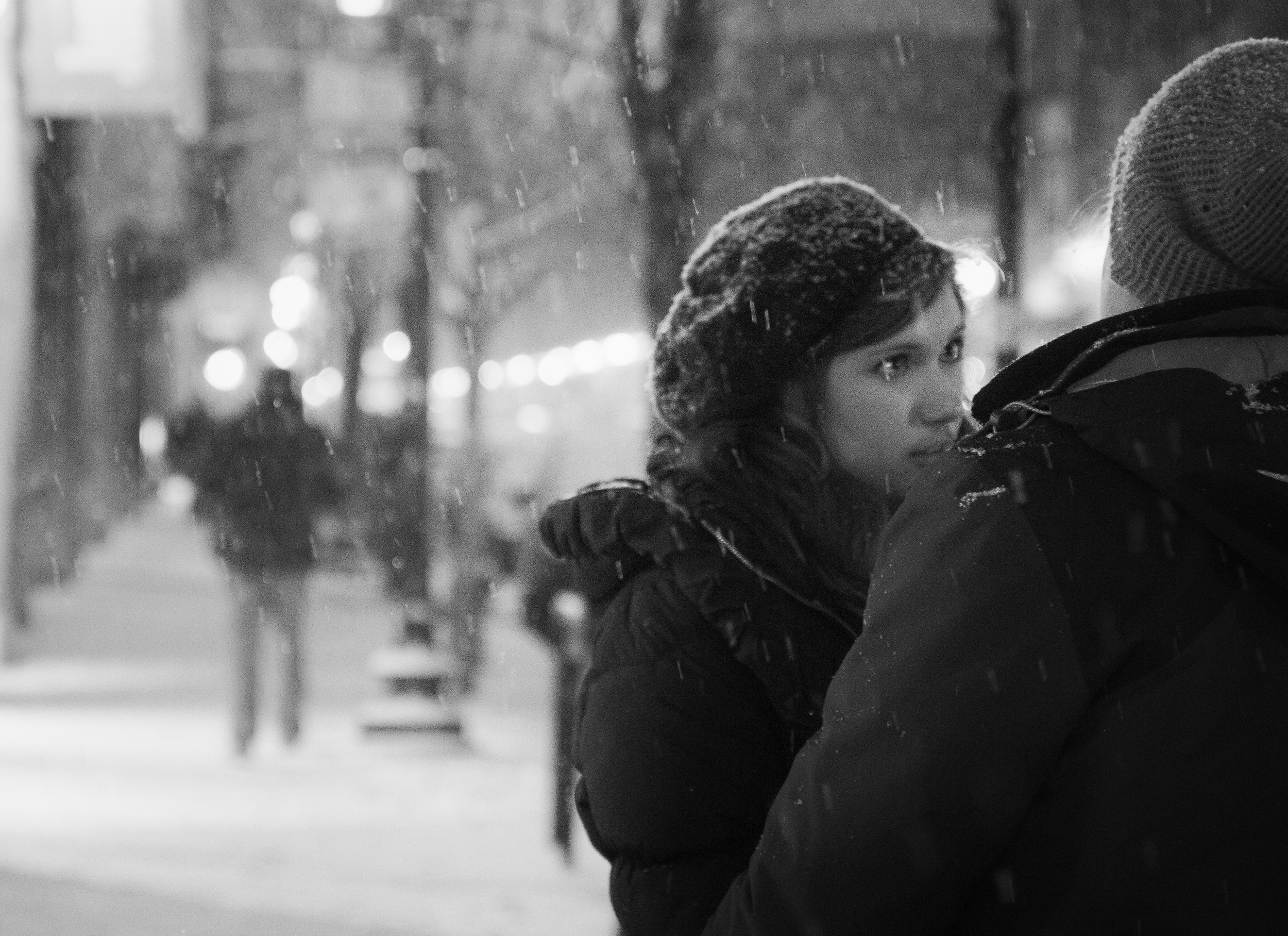
The closest you get from your subjects, the most subjective the scene will become, as was already discussed in my first eBook. This is when adding context elements can add dramatic storytelling – such as the man behind this couple, reminding us that our own personal drama can be seen and witnessed from multiple viewpoints. The presence of the stranger immediately changes our feelings toward the image – there is a direct contradiction between the strong intimacy of the couple, and the space where this intimacy exists: outside, under the snow, in the middle of a street. In front of the eyes of the world.


> Principle 2: Integrate the city
Allow the city to act as a supporting character in your street portraits

A second step in learning to create impactful street portraits relies on integrating the city as a secondary character in your images. This new character will give more meaning and depth to your primary subject, attributing thoughts and emotions that you may not have imagined. Whether you choose to leverage the lights of the city, its millions of reflections, its moving trains and cars, city elements can add dramatic substance to your portraits. Close-ups will take on a different meaning, and new emotions emerging from these interactions can provide the basis for unique stories that will draw interest in your viewers.

Use city lights as secondary storytelling elements
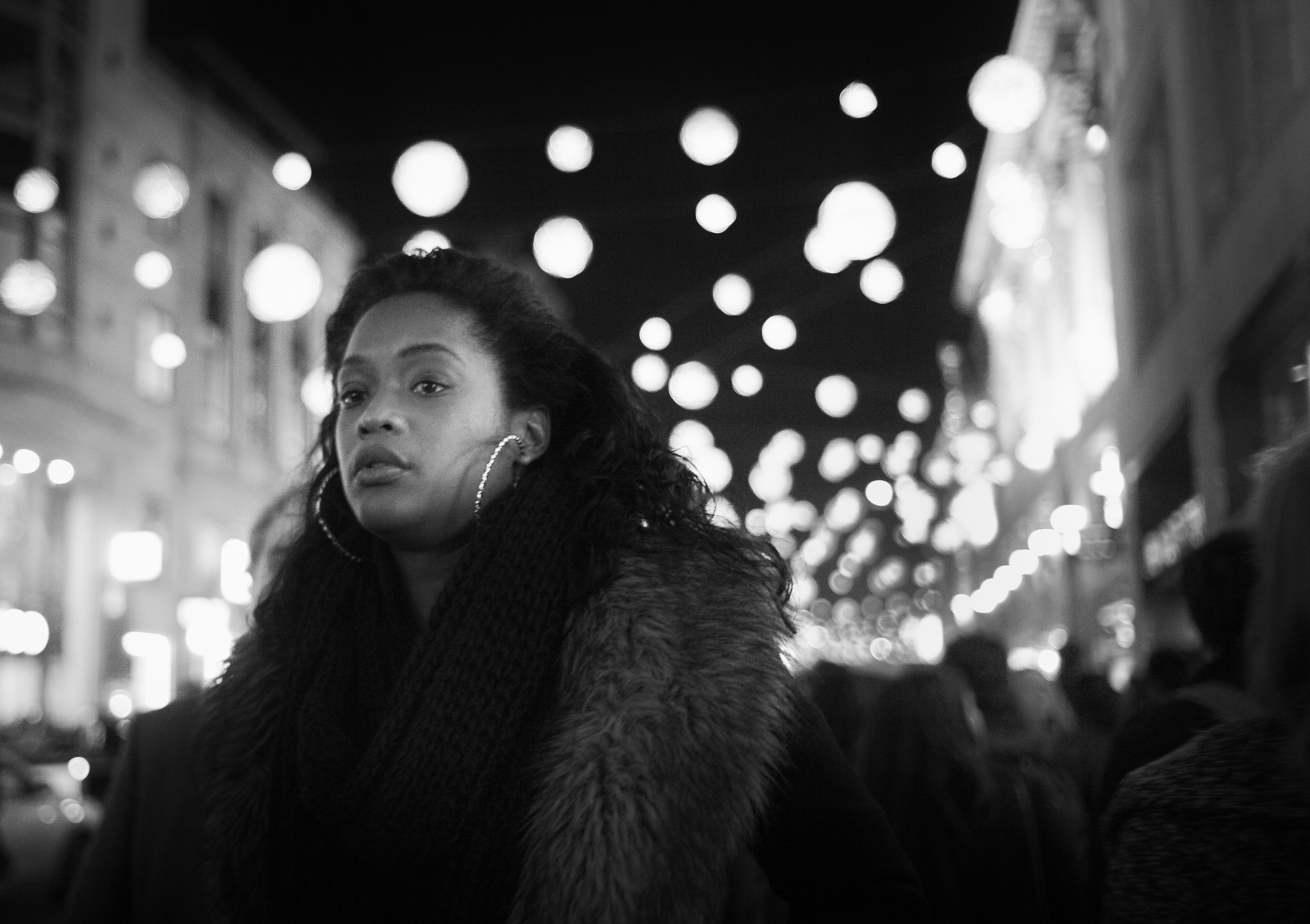
The lights of the night can add beautiful mood or storytelling elements in your portraits. At the very least, they will transform traditional close ups into more interesting images. They not only will lighten up your characters, but also instill new emotions in your viewers. In this image, the lights are used to fill in the frame like a pattern. They seem to hang in the sky, almost magically. The resulting effect creates incremental interest in what is overall a much traditional night portrait – placing the subject in a magical, surreal settings.

Capture reflections to add depth to your images
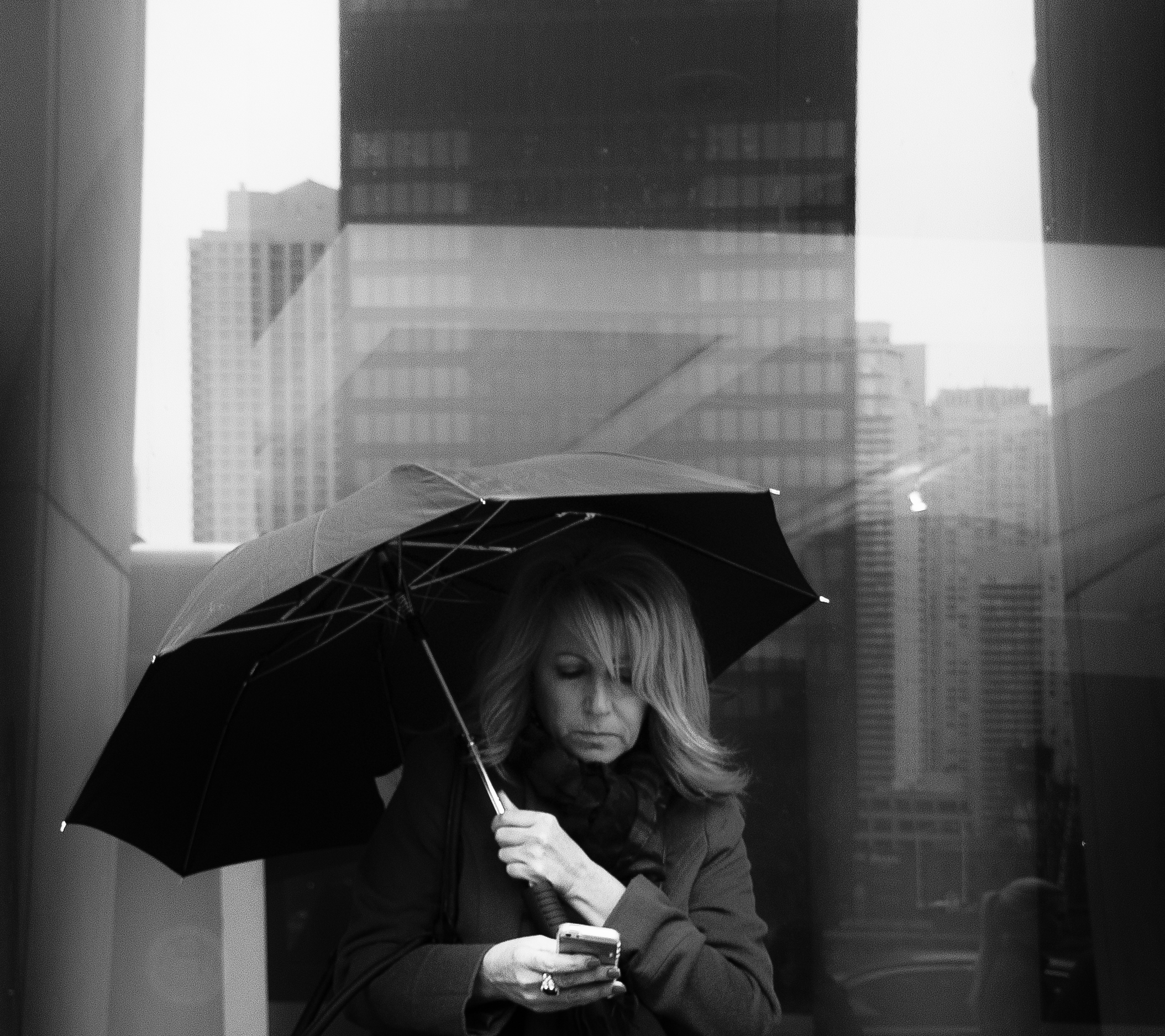
Reflections can be found anywhere, in a pond, on buildings, on windows, bus stops and cars… And they offer limitless opportunities for the imagination. Reflections of the city, in particular, can help tell a much deeper story that the subject itself. Here, in this image, the lady looks at her phone – a very common, boring scene as they often exist. But the addition of the reflected cityscape behind her adds an incremental layer of interest which contributes to the story. It becomes the story of a woman representing our busy life in the city, absorbed by a small screen, in the midst of overpowering towers and buildings.

Use motion to portray the passage of time

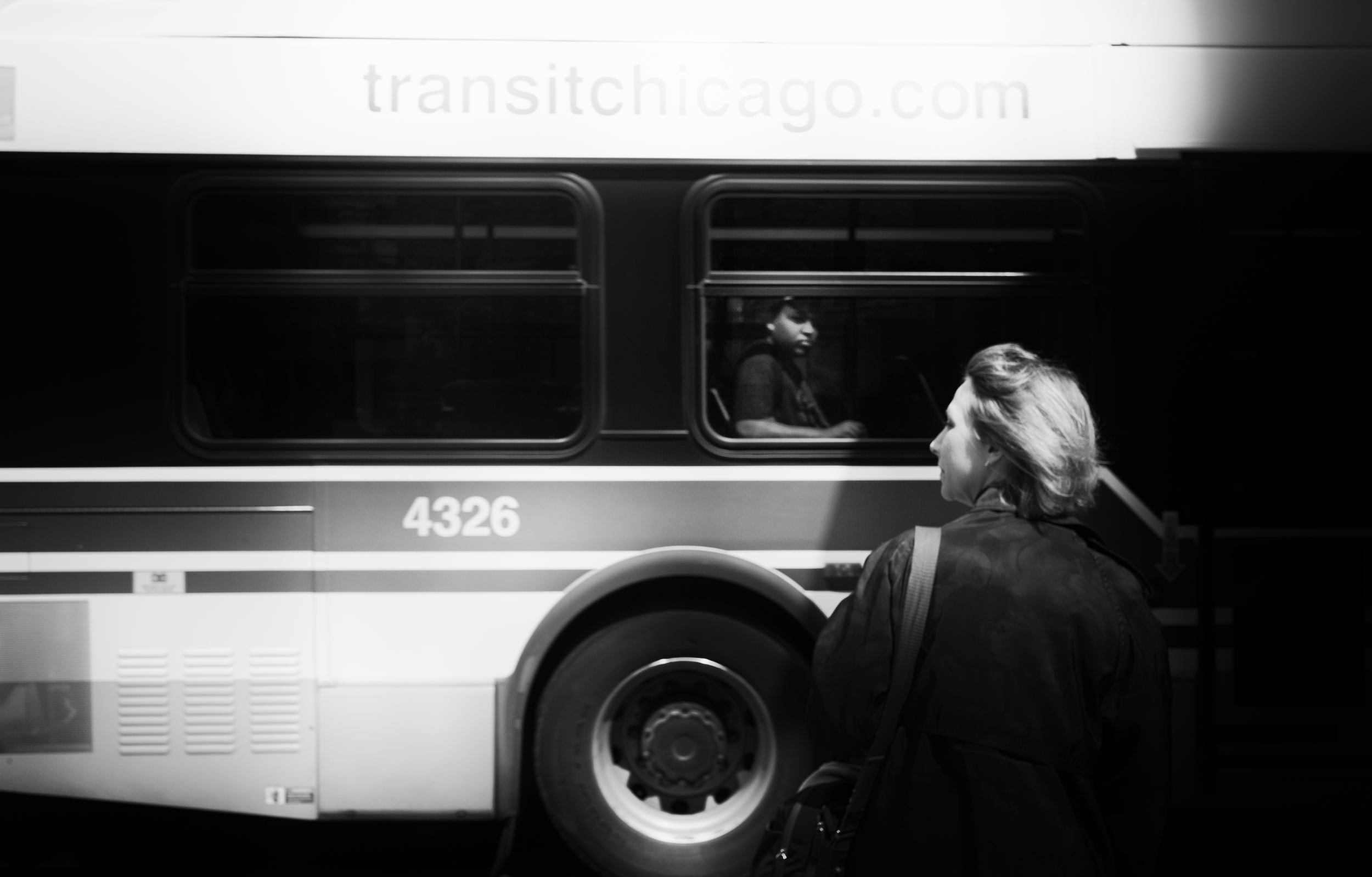
But the city itself is rarely static, rarely staying in place. If you look around you, objects are moving in multiple directions – flow of people, trains in motion, speedy cars and taxis… This motion effect can be captured to tell specific stories and emphasized existing emotions. For example, in this image, the quiet lady offers a neutral expression. But with the train behind her moving so fast that the eye can only see a trace, her attitude can take many different meanings. She appears deep in thoughts, oblivious of the world moving around her.


> Principle 3: Extend with layers
Incorporate layers to add meaning and depth to your human stories

Layers are incredibly fascinating, and so difficult to handle at the same time. Layers create complexity, but they need to connect to the subjects: they need to extend the story, not create random chaos with no meaning. When mastered, layers can add extra dimensions to the story, filling the frame with contrasting and complementary elements, placing the subject at the heart of a booming city, where people seem to connect in random yet orchestrated manner. So go experiment with human layers – giving substance to your street portrait in ways you would have not thought possible.

Extend what’s in focus to capture the world around your subject

While simplicity is often sought when taking a street portrait – in order to draw attention to the subject vs. their surroundings – a different approach can also yield spectacular results. Large depth of field can help include highly relevant context and elements that will help reinforce your primary subject. Of course, the difficulty lies in determining whether these elements are distracting, or whether they help tell a better story. In this case, the umbrella drives direct attention to the subject, connecting all other elements to the subject – and extending the image from a simple street portrait to a microcosm of life.

Play with focus to give a sense of motion or isolation

Layers can also be created with elements that are out of focus, especially when the photographer wants to draw attention to one character in the middle of a crowd. In this image, 3 distinct layers can be defined – yet only one is in focus. The resulting feeling is that of isolation. The primary character is surrounded yet alone, and the blurred secondary characters only add to this feeling of isolation. The contrast between sharpness and blurriness in this image also conveys an impression of motion within the crowd, with human elements moving in opposite directions, across different planes as well.

Coordinate human and city elements to add incremental complexity

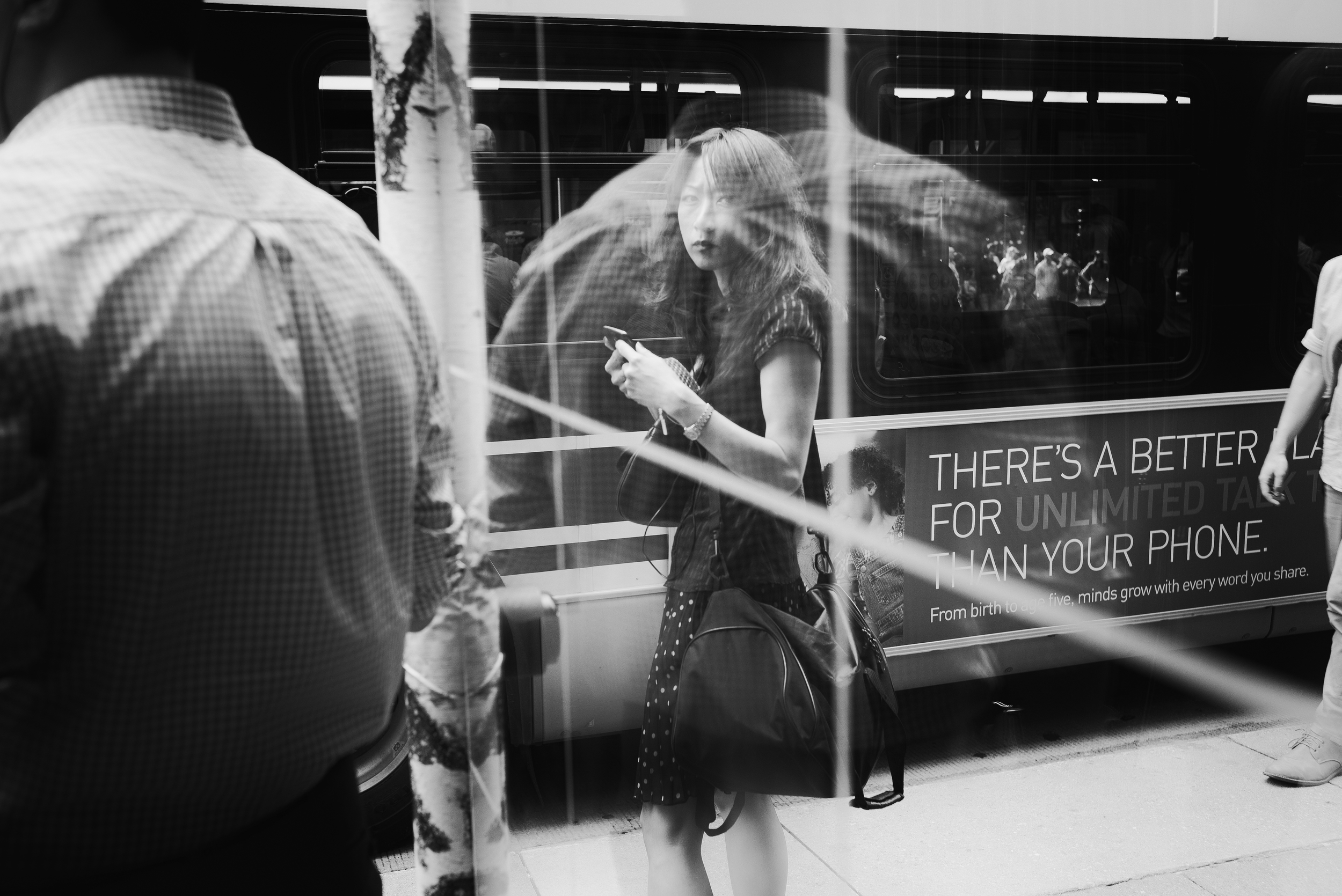
And at times, stepping back from your primary subject can let you capture a complex world encompassing random strangers, reflections, contrasts and shapes. Layers provide infinite combination of elements, foreground and background, emerging from the chaos to be orchestrated by the photographer. In this image, while appearing random at first, all elements and layers coordinate to tell a story around my primary subject. I create leading lines, blockers and double reflections that add to the story and her frowned expression without compromising the initial story at play.


> Principle 4: Shift the perspective
Shift the usual perspective to experiment and create novelty

Street portraiture should not stopped at taking usual portraits of people in the street. While the people may be ordinary, new perspectives and angles will make them appear extraordinary – at times unveiling deeper the mysterious connection existing between them and the city. Experiment with windows, perspectives, and angles to create a deeper story, full of creativity and unexpected connections. This is through looking at what could be that we may be able to unveil what’s invisible to the eyes. And this is through experimenting that we can create new perspectives on human beings.

Use lower angles to emphasize the human-city relationship
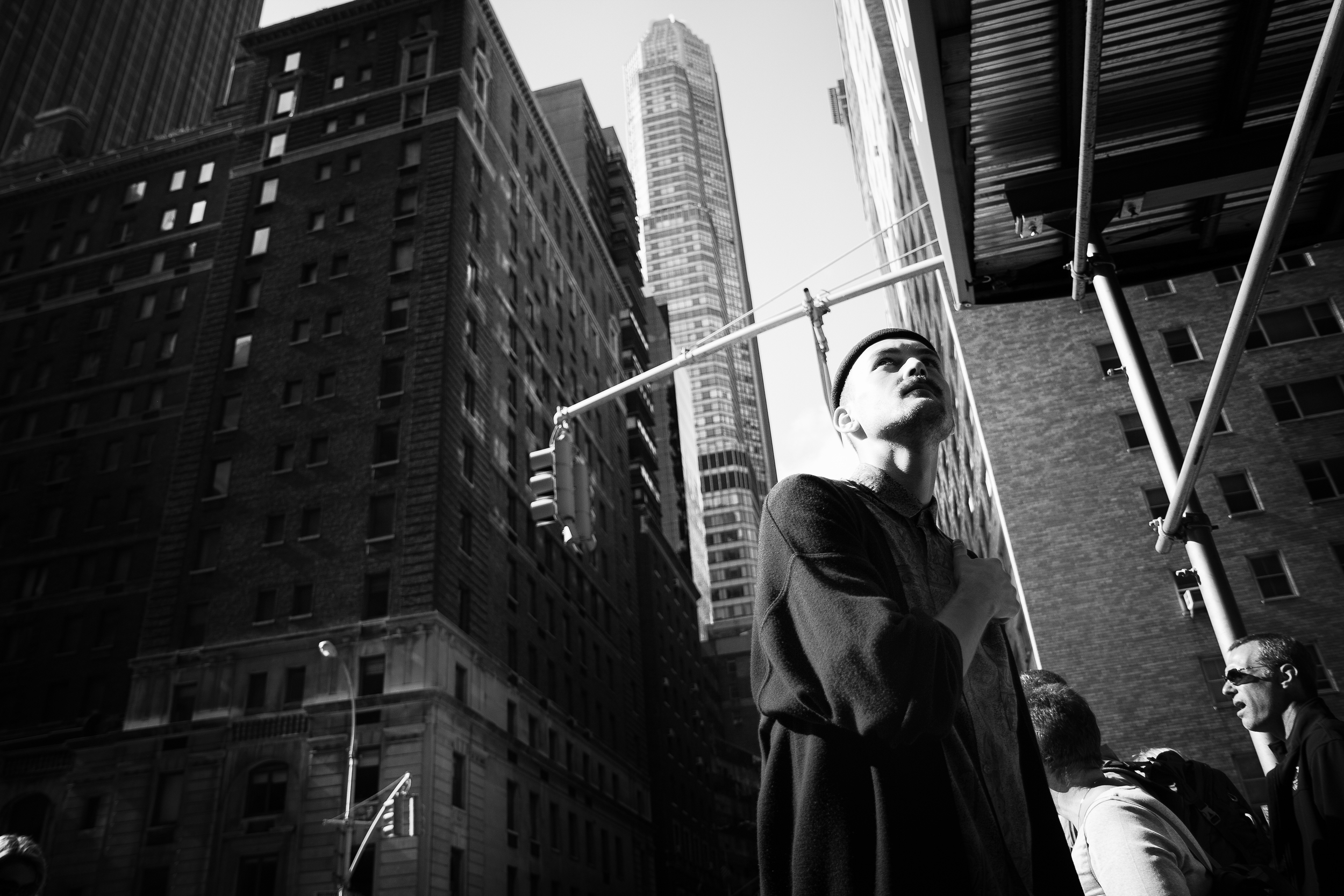
As I have explained in my first eBook, angles often create highly subjective images that takes viewers inside the story, passively, but certainly. In particular, lower angles like in the example provided here often emphasize the subject, making it look bigger than life. But angles can also create connections that would have gone invisible otherwise: connections between humans and their city, between long silhouettes and buildings, busy walkers and busy streets. In this image, the connection between the man and NYC skyscrapers is noticeable, because of the angle chosen – making us feel as if he was owning the city.

Take novel points of view and experiment with your street portraits
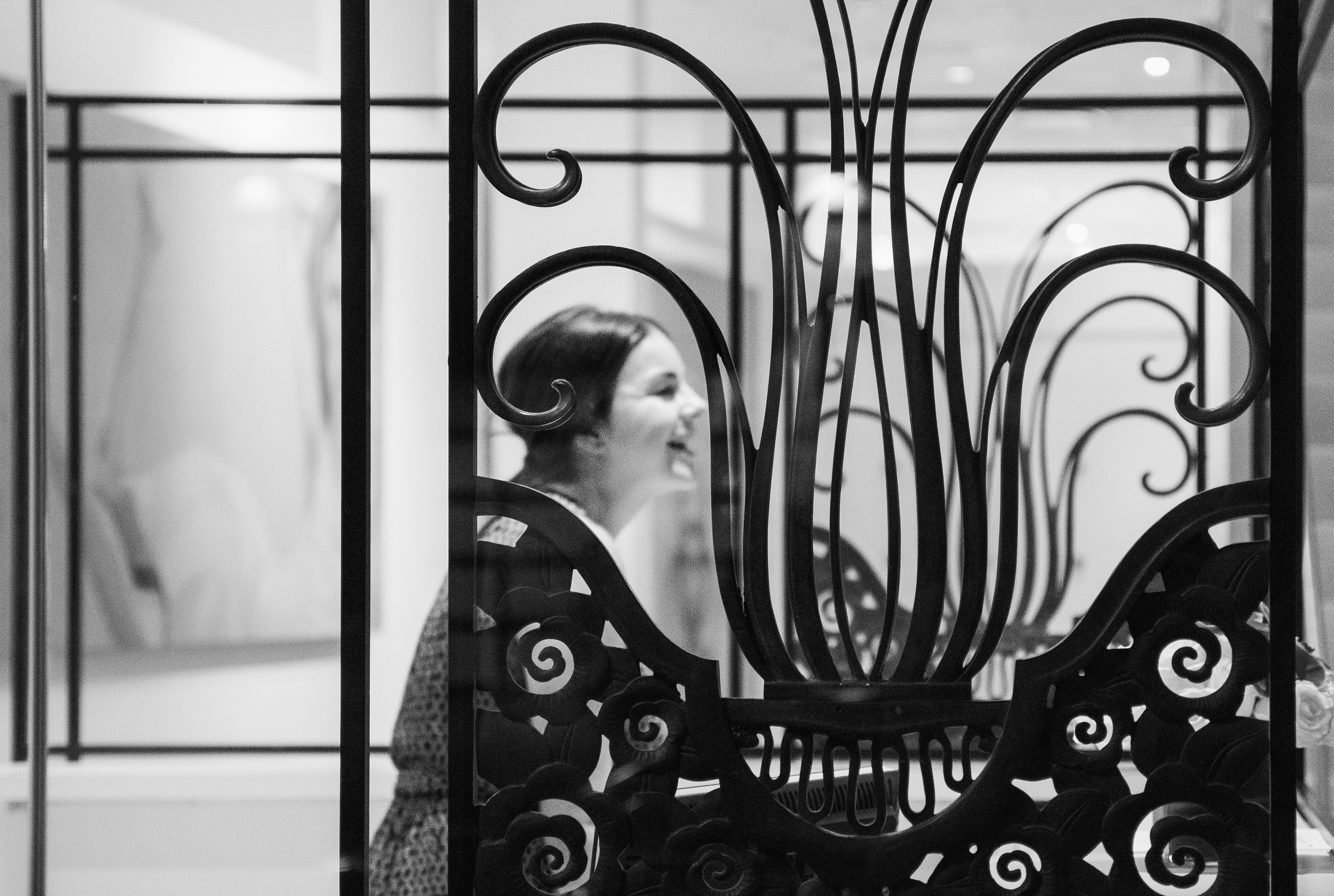
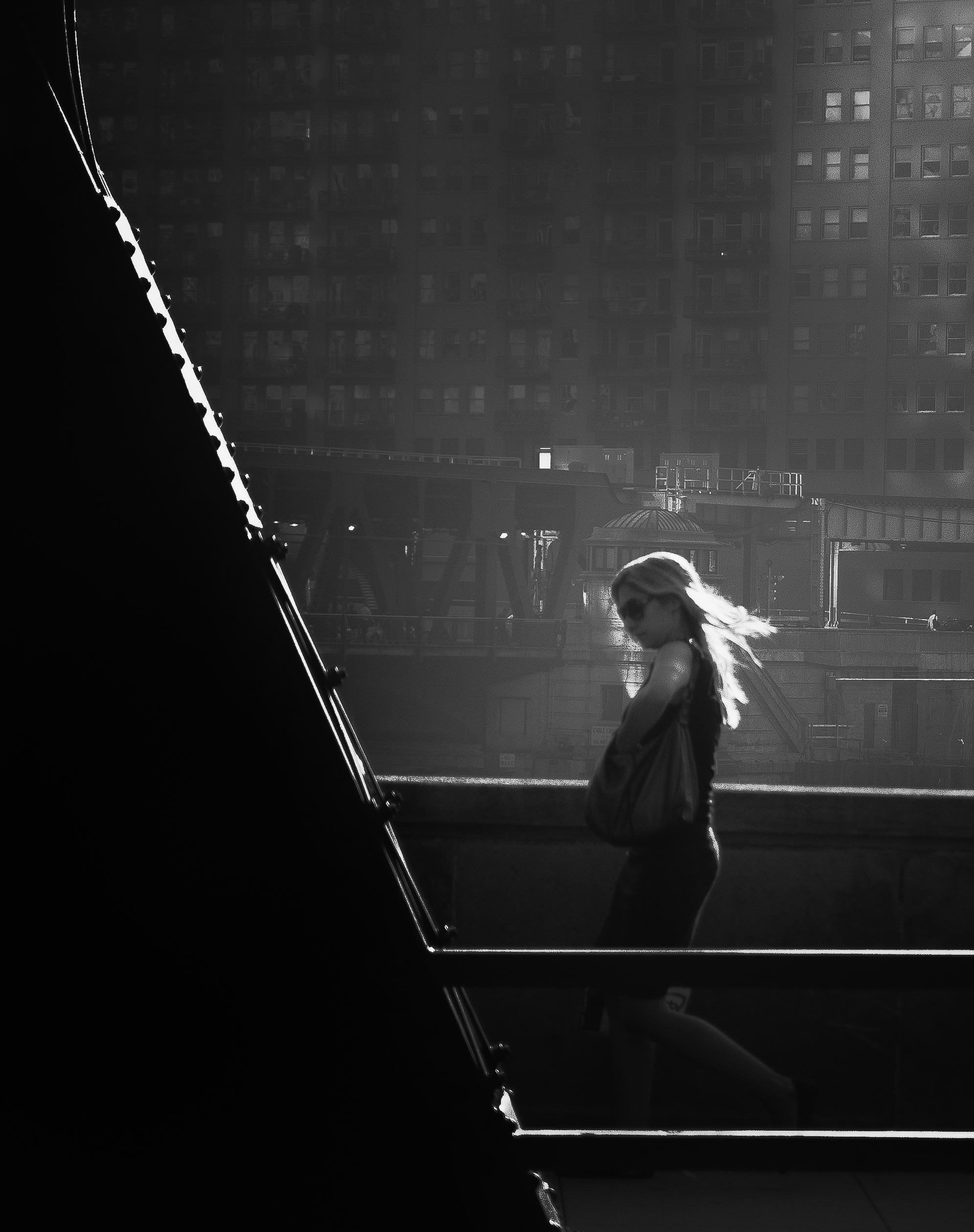
Seeking novel points of views through windows and glasses can also be very rewarding. Instead of capturing a straightforward image, here, I captured a women in a maze of steel curves – creating thereby a surrealistic settings for my primary subject. So go around experimenting yourself, looking for different perspectives, holes, windows, and other elements that will decisively take your viewers into another world, and create unexpected connections between elements.

Shift the focus away from your primary subjects to disrupt and attract

And finally, to take the experiment a little step further, I have also played with different focuses – shifting the focus away from my subject to create different emotions and stories. In this example, the camera focuses on the window frames, leaving the subject in a zone of slight blurriness, merging with the shadow of my own reflections. This not only creates appealing layers, it also adds some mystery and attraction to the subject itself – the scene becoming as important as the individual, with its beautiful light and pastel colors emerging from all sides.​ 

Storytelling in street photography: Disrupting the harmony

Tension exists when the mind cannot see what it expects to see to fully understand the story. The idea of “tension” is anchored into the Gestalt theory – a theory explaining how the mind perceives and interprets relationships between elements in a spatial configuration.

So what happens when you deprive the mind from seeing what’s expected? You force the mind to imagine the untold, the unseen. You request viewers to go beyond the frame in order to get closure. You leave open too many questions that viewers will desperately seek to answer.  In short, you create tension - and that, by itself, is a terrific fate, but one that is hard to achieve. The more tension you will add in your pictures, the greater the effort required from the mind: and the more interest will be generated as a result.

Why is that so important in street photography? Because harmony is what we see. Harmony is the ordinary, the mundane, the boring. Tension on the other hand is your storytelling ingredient: it opens the door to the imagination, the possible, the dream. It defies the predictable and the expected. It is your key to the extraordinary.


1.       Altered visual flow

The usual visual flow of an image goes from the left (top or bottom), and extends to the other side of the image, to the right edge of the frame. Harmonious compositions make every effort to follow this natural flow, allowing our minds to travel through the picture with as few obstacles as possible. Subjects will traditionally be entering the frame, “owning” the story ahead, and offering the eyes a path to explore the remainder of the image. However, that level of simplicity is rarely satisfying in street photography, as by far, too expected, too ordinary. On the contrary, the most dynamic compositions will break this flow – resulting in increased effort for the viewer to comprehend individual elements, as well as connection between those elements.

Placing the subject on the edge or exiting

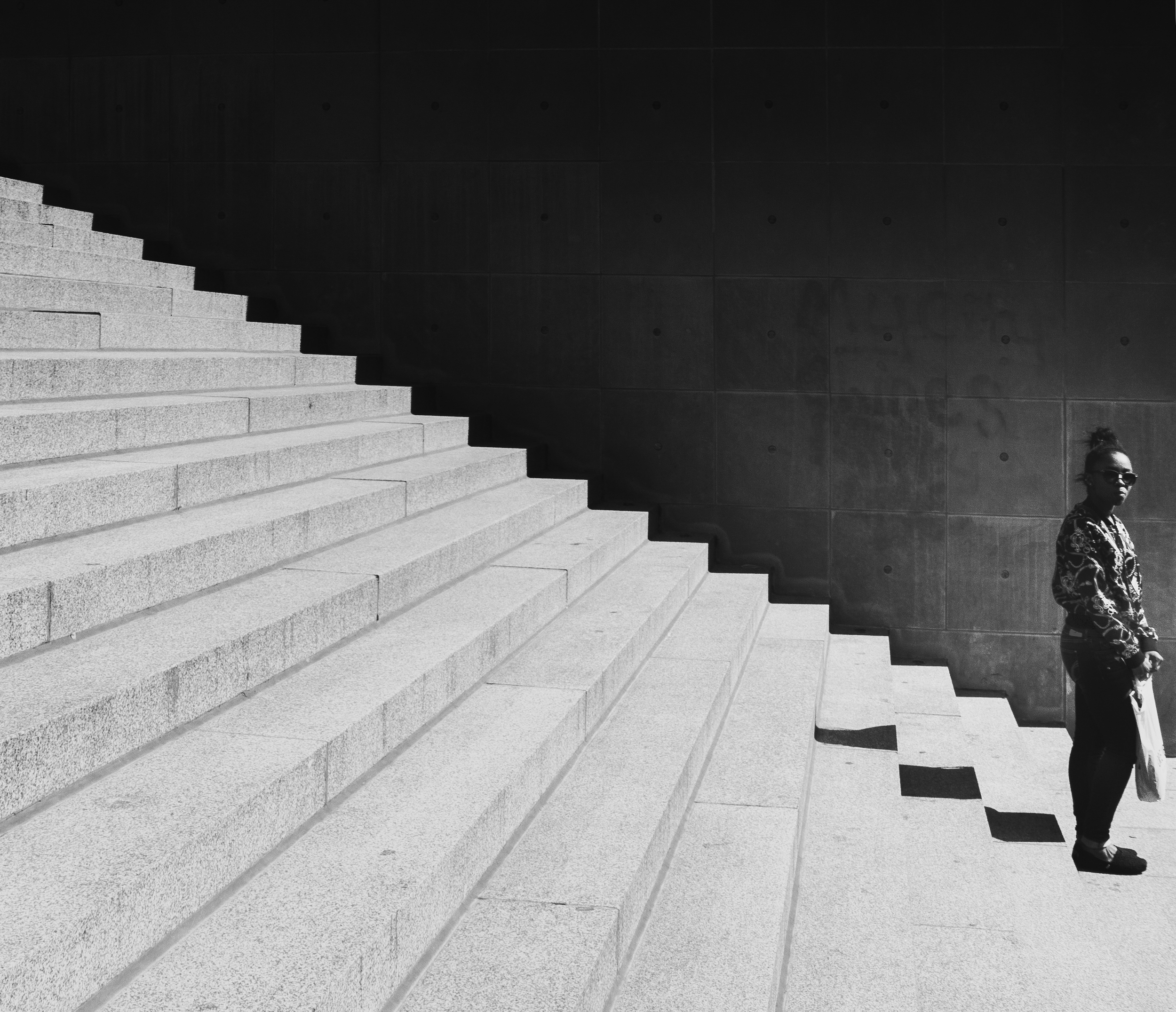
The placement of the subject in this photograph is quite unusual – nearly at the edge of the stairs, and of the frame, the woman appears to stand in a fragile equilibrium. The stairs in comparison stands out by their high graphical impact that the soft lines of the woman hardly break. The result is a feeling of tension – as our eyes repeatedly move up and down, left and right, in search for the lost harmony.

Using invisible lines

Invisible lines created by human stares are very powerful – more so than static elements. Invisible lines make this image complex at several levels. First, the power of the subjects’ stares is strong because unobstructed. The woman clearly looks on the left, to something located beyond the frame. This not only adds tension to the image, but also contradicts the natural visual flow. Secondly, the boy is starring in our direction, whether at us directly or at the woman. This creates a triangular configuration which is very dynamic, and largely contributes to the overall effect of tension here.


2.       Dynamic subjectivity

Angles and points of view, as I have mentioned previously in this book, can make a scene appear very subjective to the viewer – drawing him or her into the action, right at the forefront of the scene. Tilted orientations, close ups, low or high-level angles, as well as direct eye contact can all contribute to powerful subjectivity, creating deliberate tension. This can have a strangely disturbing effect on the viewer, who, from invisible observer, is suddenly propelled in the story as an active player. Dynamic images often use those artifacts, supplementing composition within the frame with unusual, deeply subjective viewpoints. The result is altered perception of the reality, a sense of belonging to the scene, and personal association with the story taking place.

Connecting with eye contact

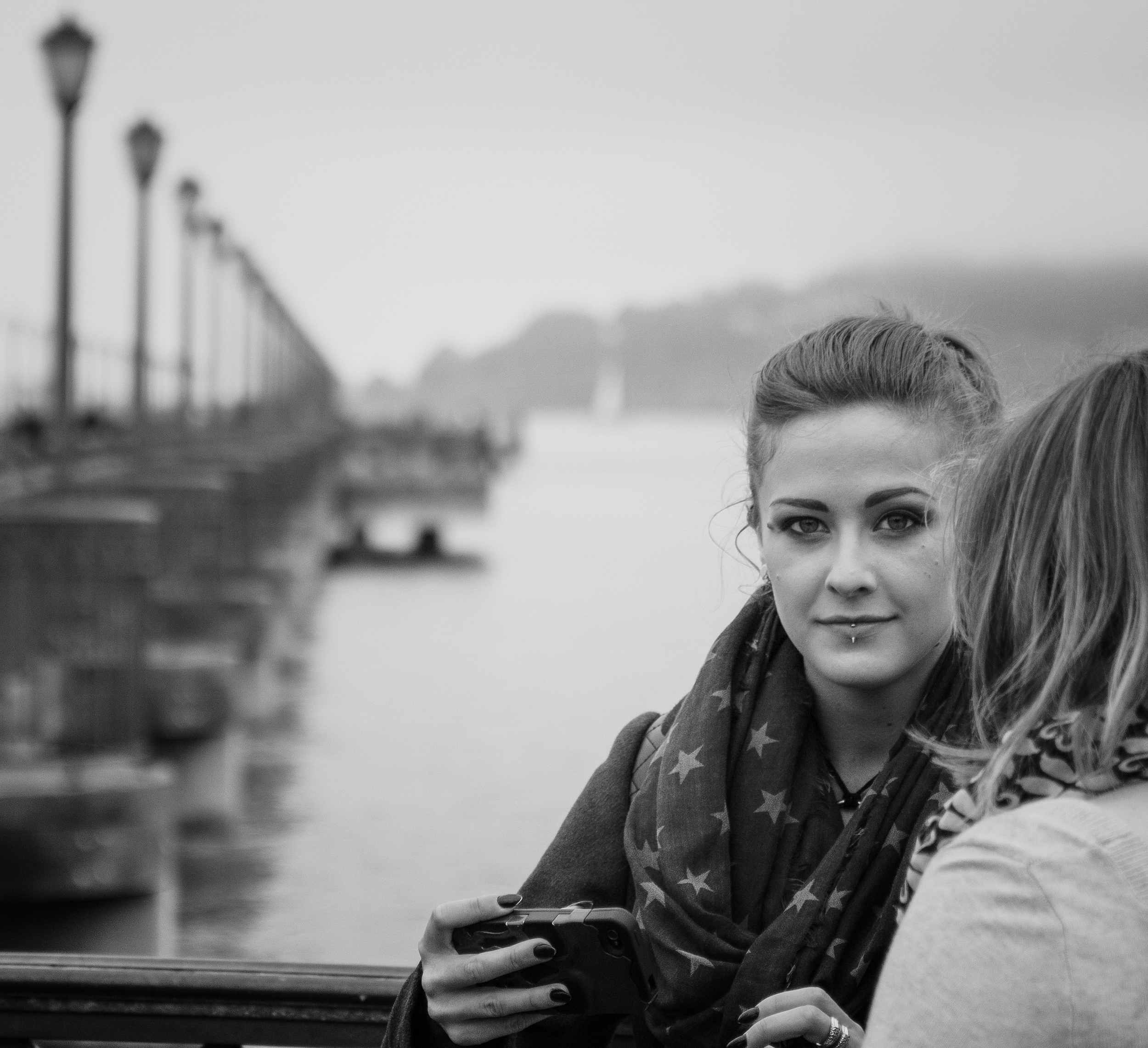
Direct eye contact can establish a strong relationship between subject and viewer. The traditional separation between art work and people viewing the artwork becomes blurred. The mind automatically connects with the eyes of the subject, as if an invisible line was being created between the two. This image is disturbing at several levels. First, the woman’s stare is definitely disapproving of the photographer – and of the viewer, by extension. This creates tension in and of itself. Secondly, the blurred reality created by the reflection of the man on top of her seems to play with our senses – disrupting the harmony of a traditional portrait, while requiring more effort to be understood.

Creating experiential moments

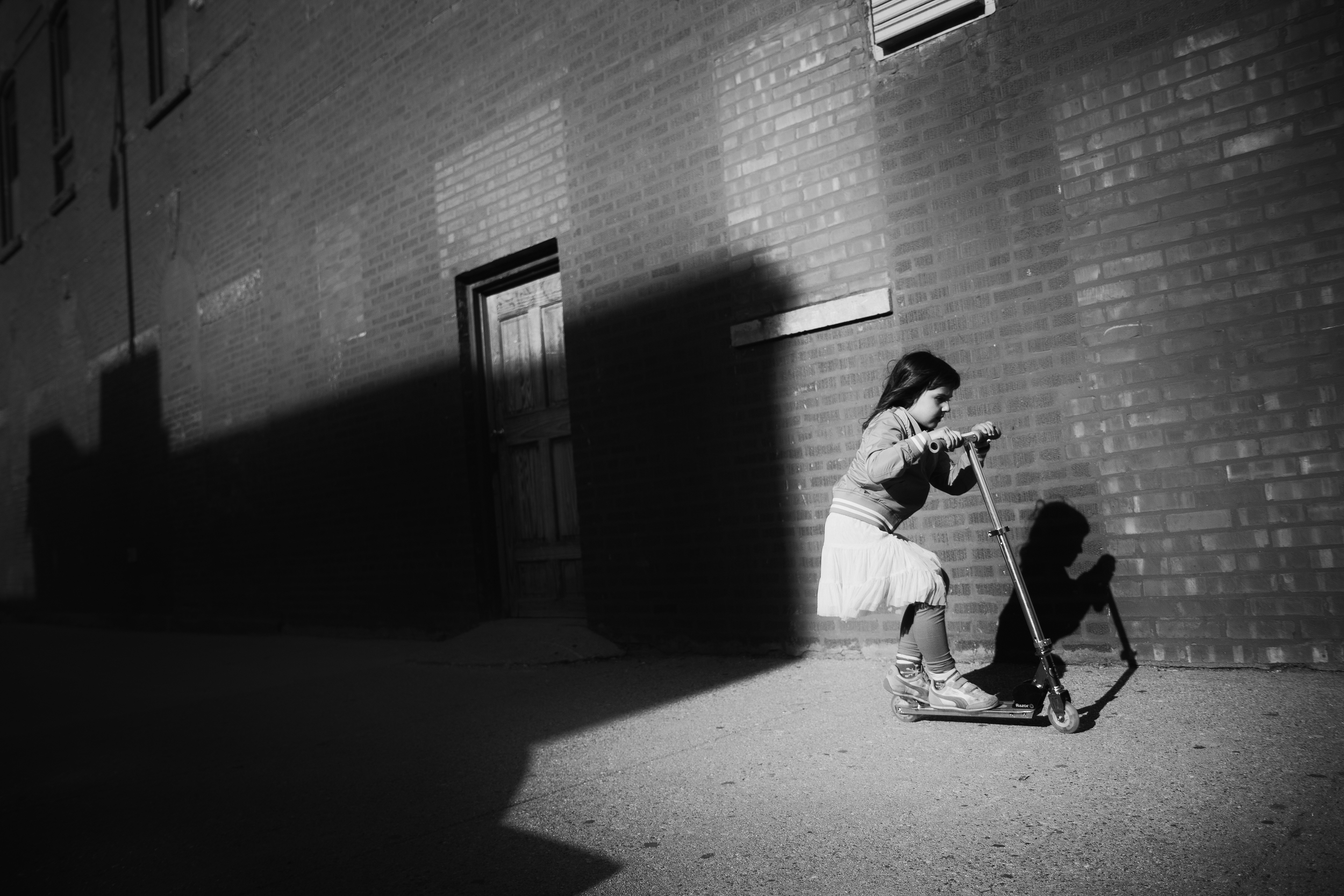
Subjectivity is a key element of dynamism in this image: choosing the right angles and viewpoints will get you a long way in creating unique pictures. The low-level angle at close range, coupled with a titled orientation, puts the viewer at the forefront of the action. Additionally, tension is created by the large mass of blackness that seems to follow her. Finally, the fact that the little girl is exiting the frame – not entering – suggests almost an escape, a frenetic attempt to run away.


3.       Subject minimization

Traditionally, good composition is meant to direct the eye to the subject. Everything we do is aimed at separating the subject from the foreground AND background in clear, indisputable terms. Let’s think about what it means to break that rule: what if my subject cannot be easily distinguished from the environment in the photograph? What if your subject appear lost within their massive surroundings? Then discomfort comes in as the mind cannot properly process what’s going on. The original distinction between subject and environment doesn’t really exist – one and the other are interchangeable, part of a bigger scheme. It will demand more effort to understand your picture. And in many instances, more effort equals deeper interest.

Giving a sense of exaggerated proportions

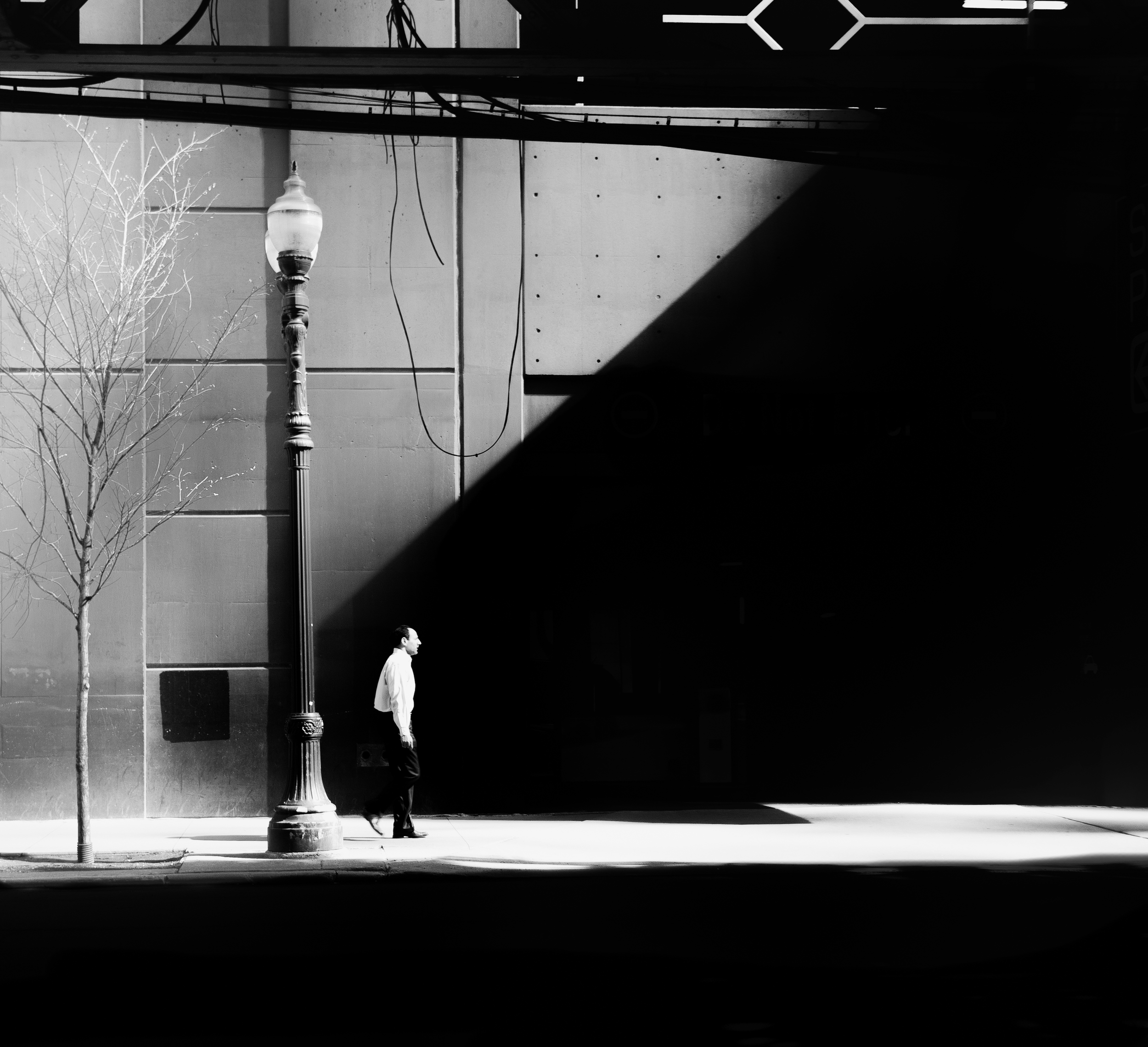
The image is all about exaggerating the proportions of the city in comparison with the subject. As you can see, the size of the lamp post as well as the massive triangle of pure black position the subject at the very bottom of an extravagant urban structure. The man appears lost in this urban jungle, faced with a never-ending wall of blackness, and surrounded by large pieces of steel. Even the tree seems frail and vulnerable compared with the tall lamp post. This resulting sense of scale adds tension to the image, suggesting that the subject is, in a sense, at the mercy of the overpowering city.

Blurring the line between figure & ground

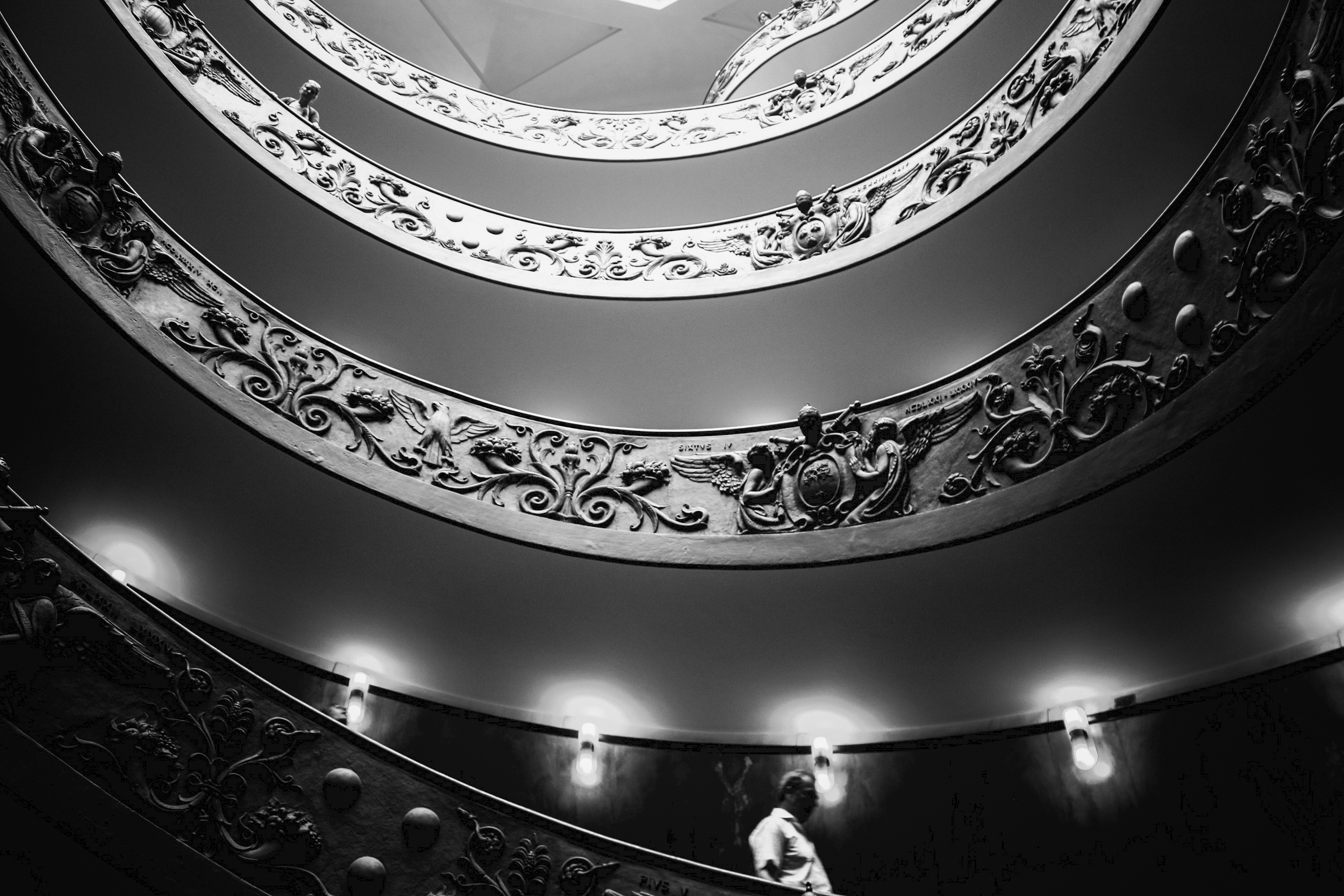
In The Stairs, the man is quite visible at the bottom of the picture. But as the eyes travel up to the top of the stairs, the difference between ornamental objects and human figures become increasingly blurred. Are these men looking down at us or are these vestiges of the past? Blurring the lines between figure and ground forces viewers to re-evaluate the image a second time – and perhaps, get lost in the labyrinth of possibilities.


4.       Open-ended stories

The human mind needs closure. There is a need for a beginning and an end to everything. In fact, the human mind cannot easily tolerate gaps, nor can it be sustained with allusive answers. This is why playing on that weakness can be surprisingly successful in photography and art in general. The resulting ambiguity is intolerable, and in order to make sense of the whole, the mind is forced to fill in the gaps, making its own interpretation of the scene and the story. As we can expect, this requires effort, and effort means increased interest. And this is perhaps the most important insight to remember: suggesting stories can be far more impactful than simply telling them; it allows the viewer to make it their own, and their own only.

 Keeping key elements in the dark

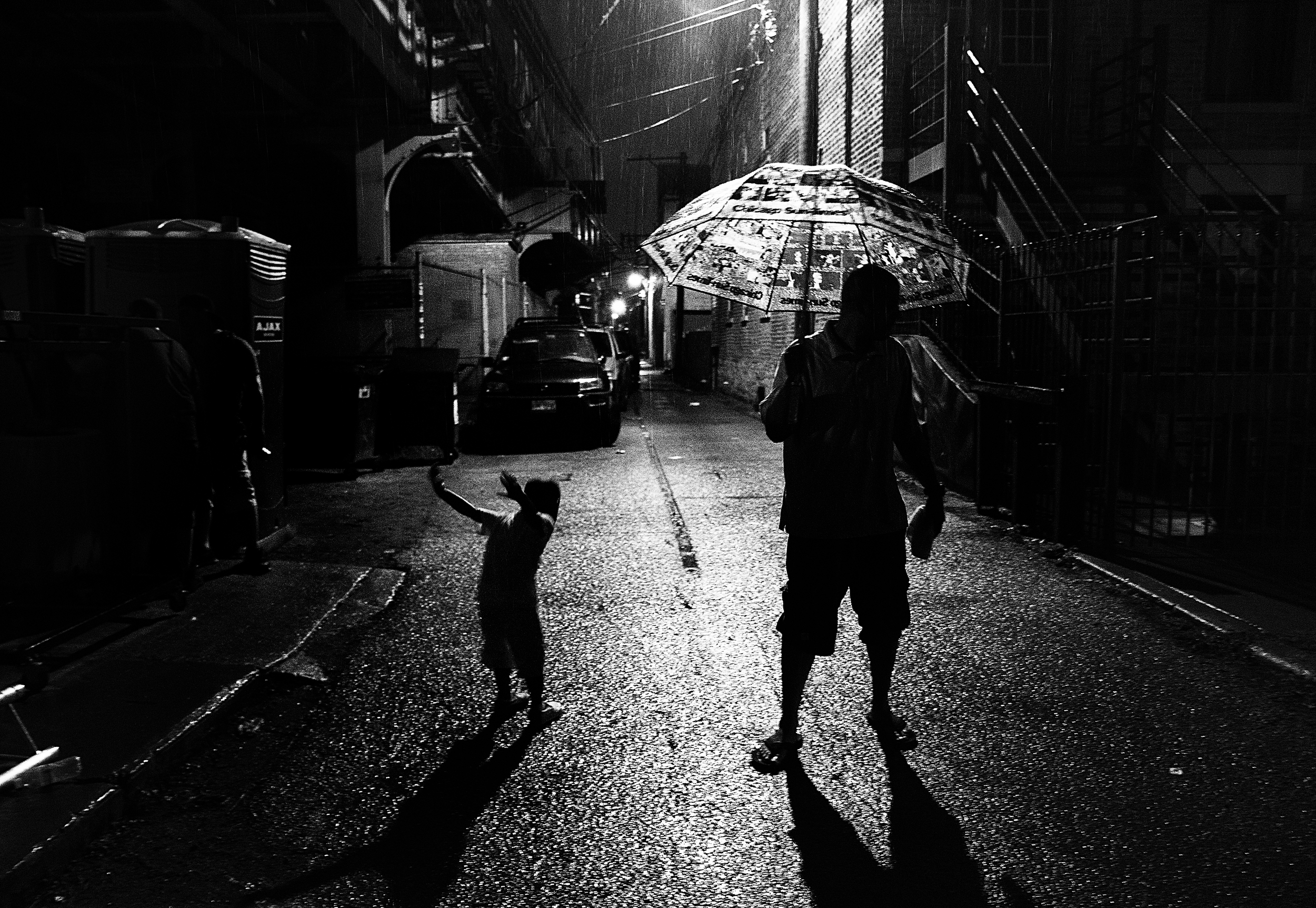
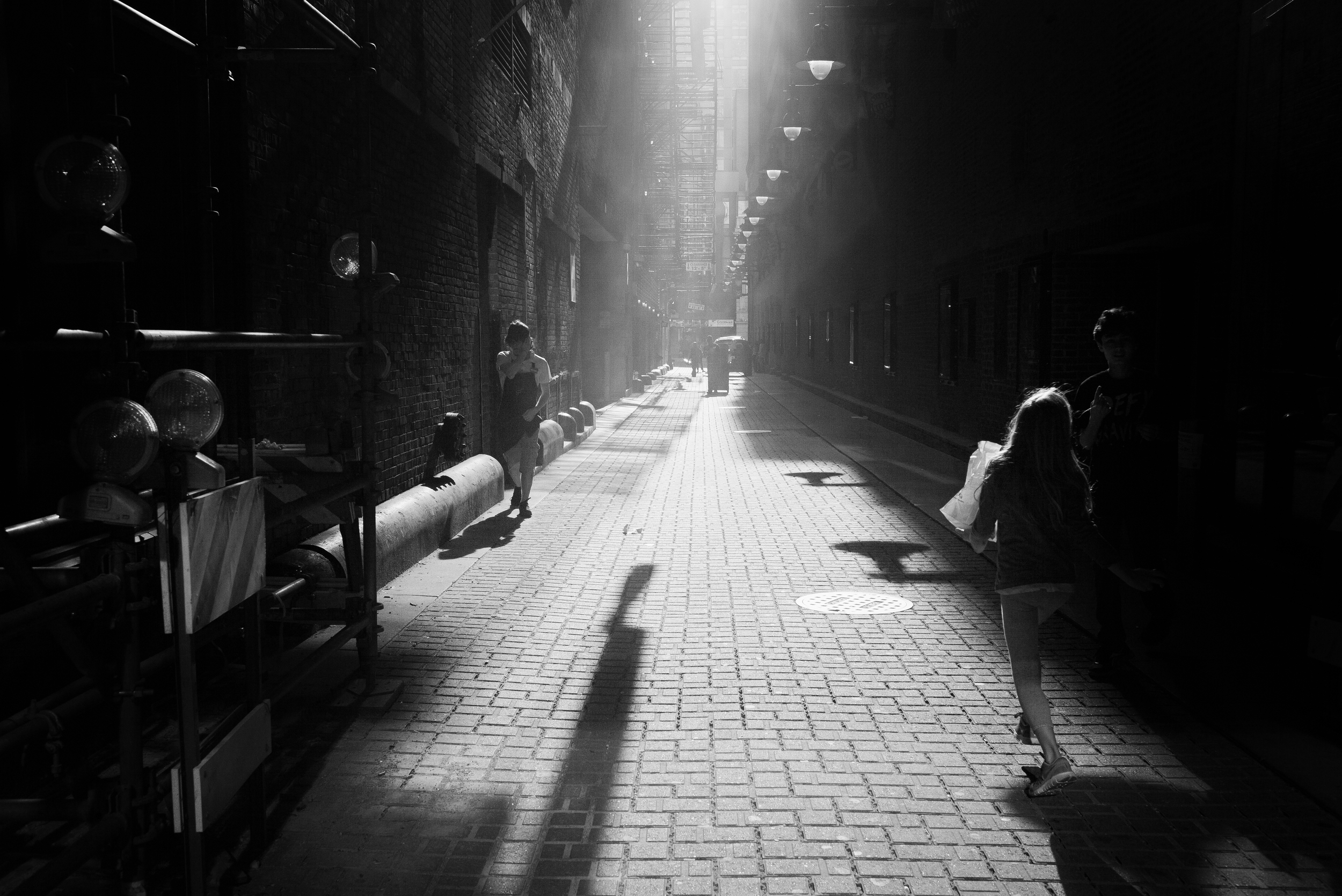
By hiding key elements of the scene, or key features of the subjects, we are in fact inserting gaps in the story – something that the mind cannot accept. This image has been interpreted in so many different ways, since I shared it publicly. The reason is simple: it only tells half of the truth. The subjects are mere silhouettes, whose expressions is hidden and can only be imagined. While the little boy appears to be jumping around, the gloomy light sitting across the dark alley conveys a feeling of ambiguity to the story – revealing too little to establish a clear and common storyline.

Not providing all the answers

This image doesn’t tell a story, it only suggests one. The subjects are looking up at something located beyond the frame, and for this very reason, the story remains a mystery. This results in a more engaging image, left to the imagination of the viewer. What can they be looking at?

There you go. This was the last chapter of my first eBook, Storytelling in street photography – Creating impact. Soon I will publish the second volume of this series, entitled: Understanding the human and city relationships, providing a unique perspective on composition and storytelling. Hope you’ve enjoyed the reading, and I wish you a lovely day full of photographic surprises!

Storytelling in street photography: Transforming with light

Light – and the absence of light – is inherent in all photography. Photography literally means: “Writing with light”. The amount of light coming in your sensor will ultimately determine what your image will look like from an exposure perspective. But light is far from being neutral – it shapes your image, it emphasizes your story, and can ultimately transform the reality to create new worlds as mysterious and powerful as those found in our dreams. Knowing when and how to use light is key to creating greater impact with your photography.

In this chapter, I explain and analyze 4 different effects that light can have on your image and your story, looking at it as a continuum: from very basic tonal differentiation to radical light transformation. The transformative power of light has no limit - it is a world of possibilities that I encourage you to explore. Now.

1.       Creating separation

At the very basic level, light acts as a separator between your subject and the background. Back to the core of our perceptions, the human mind can only distinguish elements in visual art if, and only if, they have different colors or shades of a similar color. In B&W photography, when colors are de facto absent from your composition, the only way to define your subject vs. the background is to create tonal differentiation. In other words, you need to capture elements with different values of light if you want them to be distinct from one another.

Separation: Light subject vs. darker background

In this image, the lady walking is clearly distinguishable against the background. In fact, I waited for that very moment to take the shot, as I wanted her head and face to contrast against the background. Since I was range-focusing (i.e., using a small f-stop to ensure that a maximum number of possible subjects would be in focus, regardless of their distance from me). Although useful, this technique also brings far too many distractions: foreground and background tend to be a long continuation from another, making it hard to separate the subject from its environment.

Separation: Dark subject vs. lighter background

Tonal differentiation also works the other way, with a darker subject positioned in a lighter background, as in the photograph here. In both cases, the distinction between figures and ground is clear and indisputable, which is the basic essence of traditional composition. The separation in this image is further created by the shallow depth of field, a useful tool to bring up subjects at close range.


2.     Generating emphasis

A more advanced use of light in your composition can allow you to emphasize your main subject. In other words, light can help create better stories if used smartly and appropriately. Think about how light, and its opposite – darkness - can contribute to your composition: leading lines, blockers, frames, negative space. All those elements will support your story by leading the eyes to what really matters – and get rid of what doesn’t.

Emphasis: The effect of selective lighting

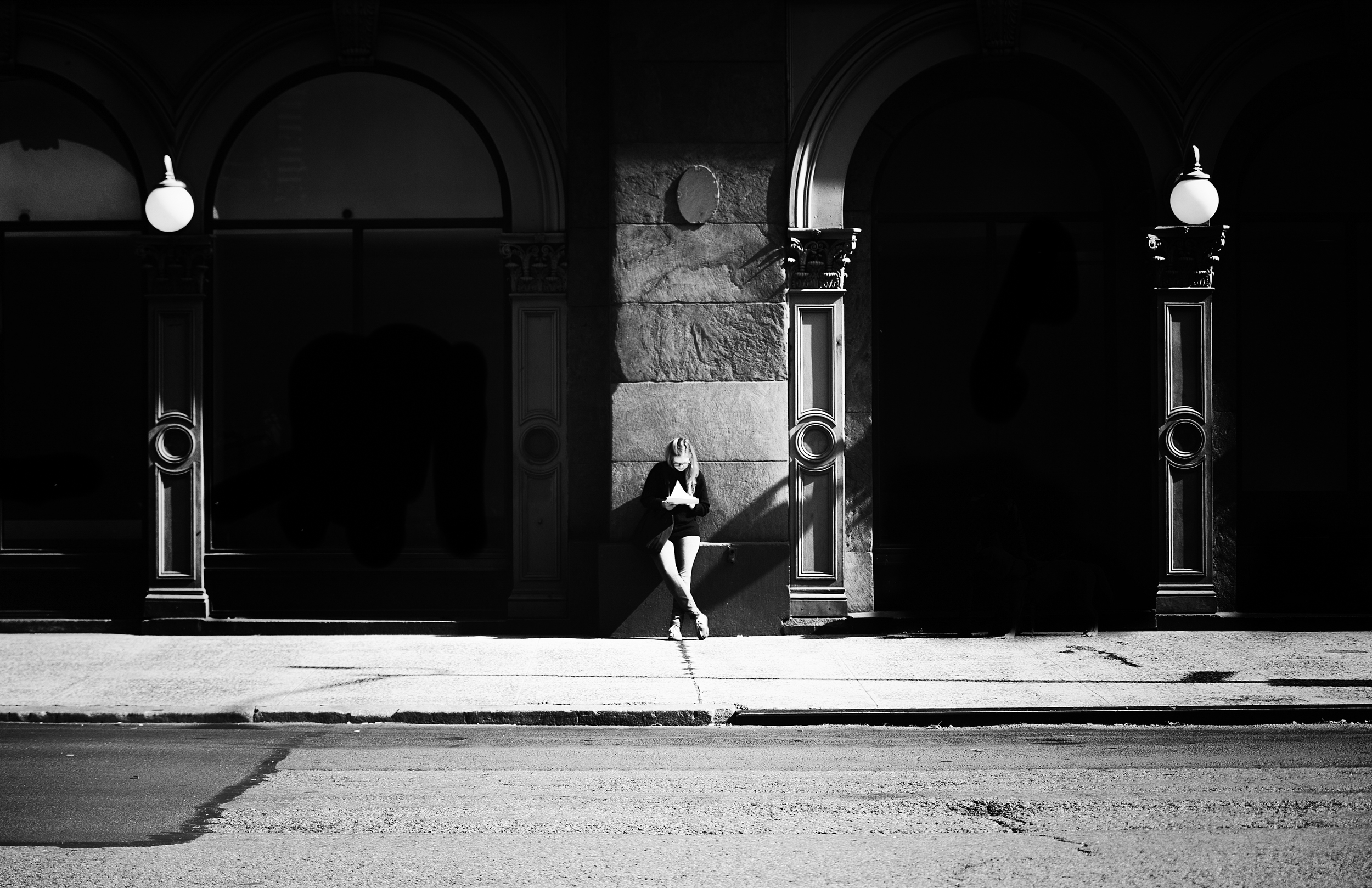
In this image, the use of light is more sophisticated: it shapes the story and the image. By applying light and darkness selectively – in areas within the arcades, I not only clearly separate my subject but also isolate her, thus creating that feeling of silence and strange quietness that seems to fall on her.  The eyes are unmistakably attracted to her, while the exploration of the darker zones on her right and left leaves us wondering what can be hiding behind.

Emphasis: Leveraging negative space

Another purposeful use of light is negative space. Dark negative space brings up feeling of loneliness and silence, while light negative space will generally convey more positive feelings. In this shot, the negative space not only highlights the two subjects, but also brings them in contrast to the wide and empty city behind. The eyes move from the couple to the massive city sleeping behind them, structured and shaped by light and dark. The sense of perspective is amplified by the tonal variations at the center vs. extremity of the city, providing an interesting counterpoint to the couple.

Emphasis: Leading the eyes to what matters

Light can also act a blocker, like that shiny ray of light on the steel of the bridge in the picture below. The line created separates the photograph into two distinct areas: the dark part of the left, where our eyes do not want to stay or linger too long, and the brighter part on the right where the subject stands. As a result, more emphasis is given to the subject, as the eyes are forced to shift on the right and rest on the illuminated face of the woman.


3.       Adding substance

Furthermore, light can create elements of its own – secondary actors that will help you tell a more subtle and powerful story: silhouettes, shadows, reflections. Those elements often convey more mystery and depth to your stories, helping to emphasize underlying emotions in your images. Those elements will create substance if they reinforce your existing story – which means, if they do not contradict the story in place.

Substance: Creating meaningful atmosphere

Light can add tremendous substance and depth to the story when it generates additional atmosphere. The light in this image is making the shot: this is because the atmosphere is misty and mysterious that our eyes wonder a little longer. The scene itself and the protagonists do very little to capture our attention, but placed within this explosion of light, they become timeless and memorable, just as the story.

Substance: Capturing stolen reflections

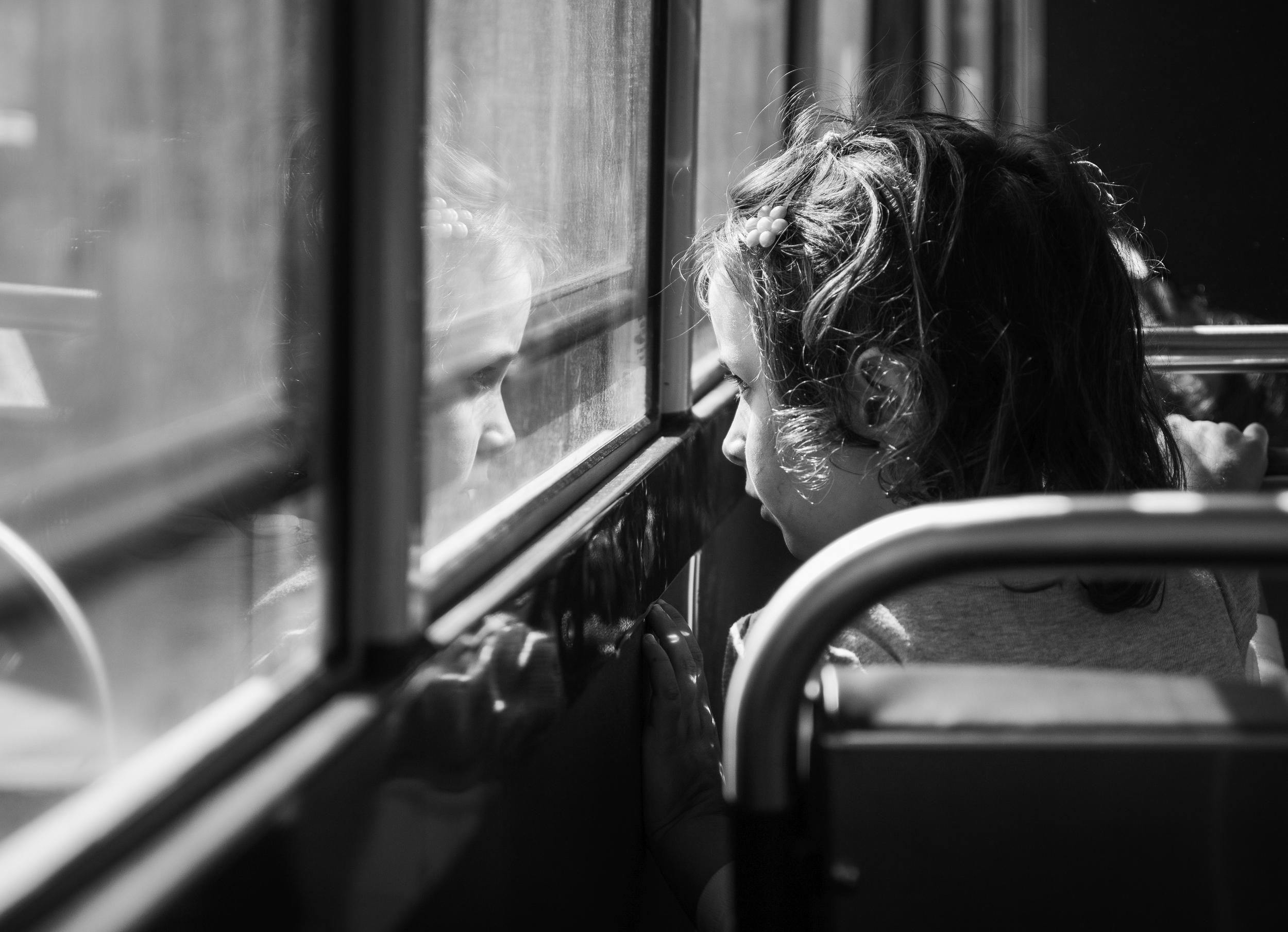
The sun has this wonderful aptitude to create new elements in photographs. Reflections are one of those elements that only light can create, and, if used properly, will add significant substance to your story. In the photograph below, the little girl looking beyond the window is facing her own reflection. Elements respond to one another – as if her reflection was an extension of herself, and extension of hey journey into her mind.

Substance: Shadows as extension

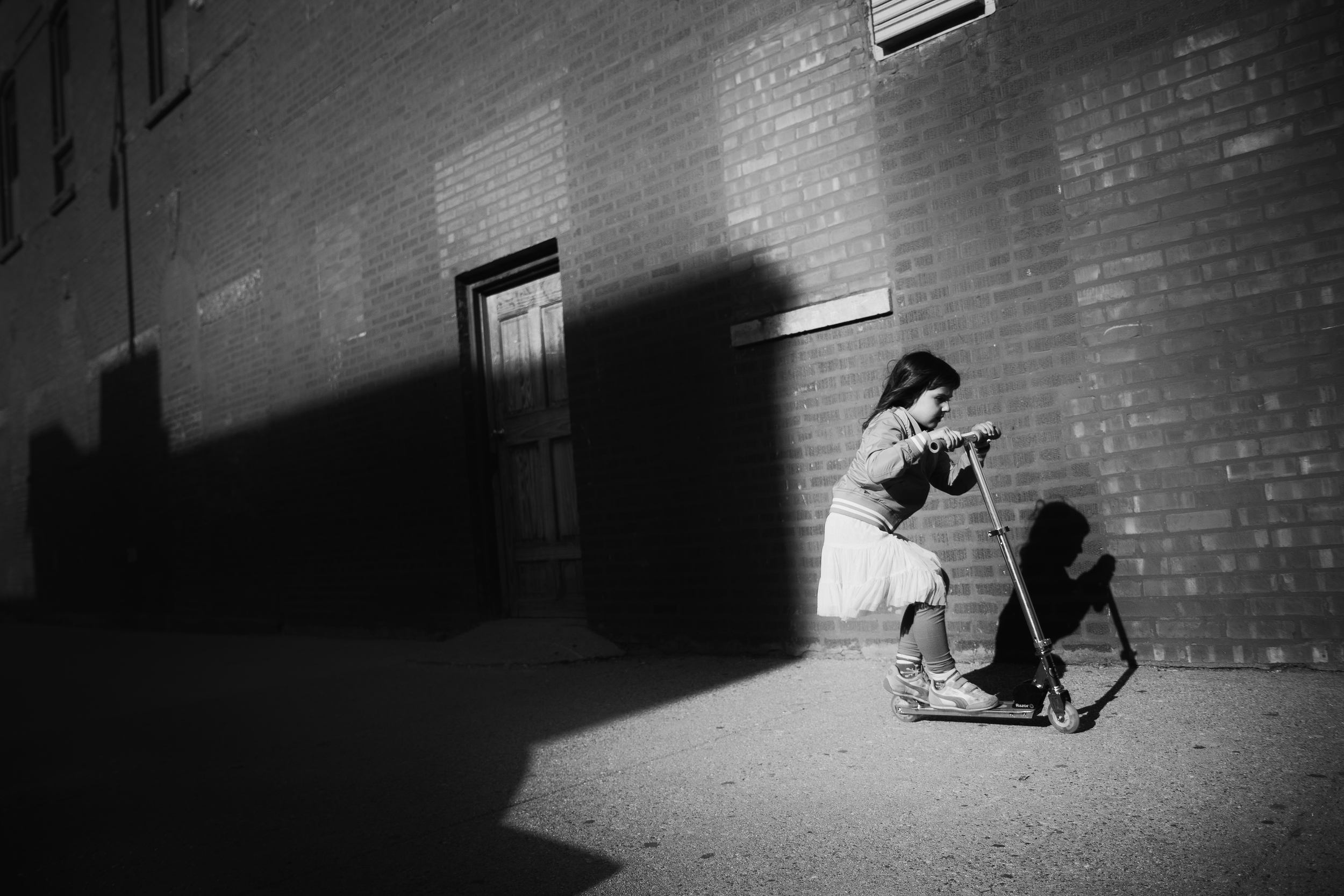
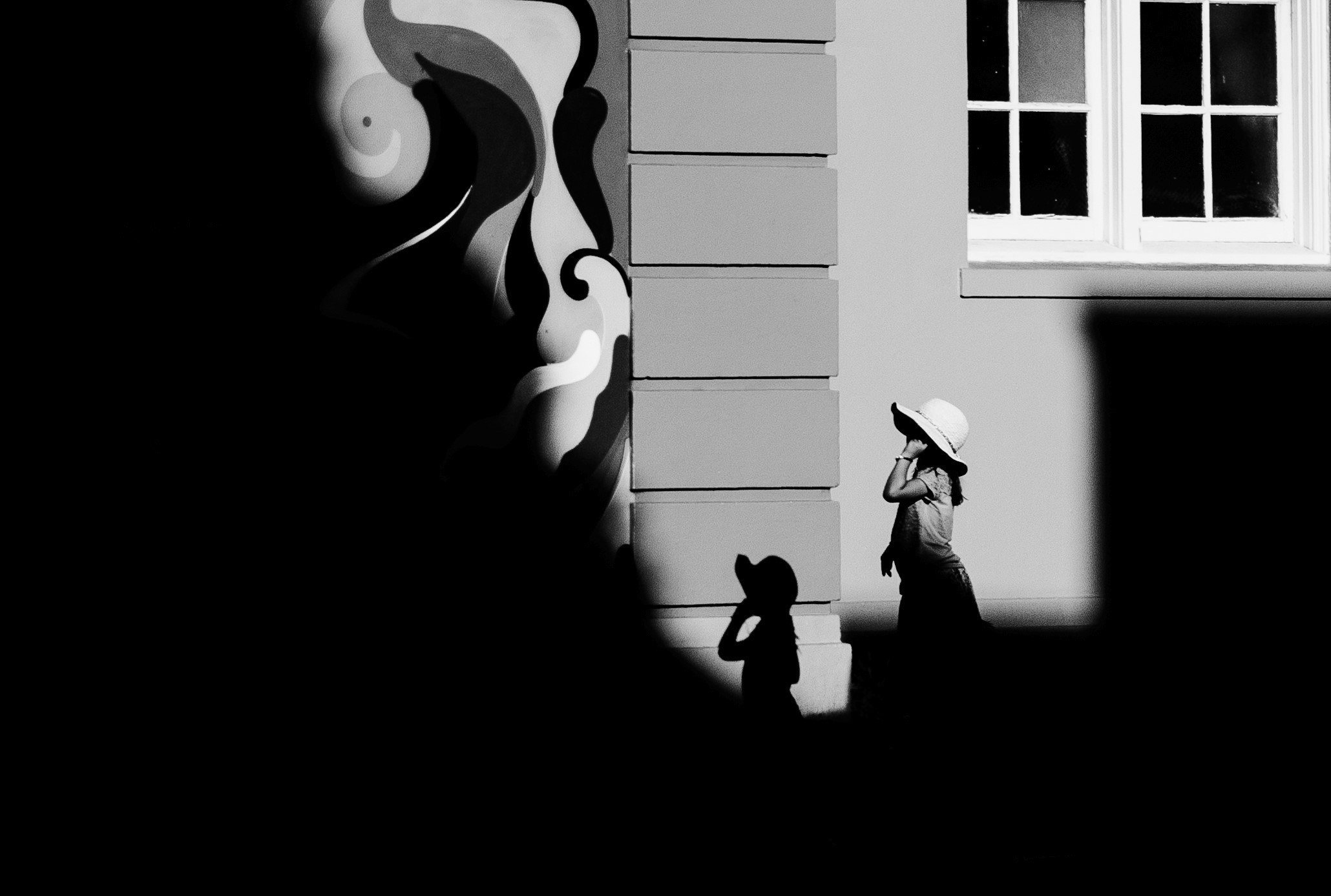
Shadows – that other artifact created by light – have a strong symbolic value. They tend to show that we are dual in our humanity, that there are two of us – the dark and the light, the reality and the dream. In the picture below, the shadow of that little girl is enhancing the story, not creating conflict as we could suppose so. That little girl alone imitates the world of adults as she proudly wears her feminine hat, yet behaves like a child in her attitude and posture. Her shadow and negative space around only enhance that story by offering a representation of that world of hers, of that imaginary place where she stands – bridging the seemingly separate worlds of childhood and adulthood.


4.       Creating tension

The most powerful impact of light that can be found in photography is to create meaning. When new elements created by light – or absence of light – detract and contradict the story in place, you are in fact creating new meaning. This is probably the most interesting and inspiring use of light for street photographers. New meaning will be created if, at the end of the day, elements with contradictory meaning come together to form a greater whole. This is the power of opposites – stirring emotions in multiple directions to create, ultimately, meaningful tension.

Tension: The opposition of light and dark

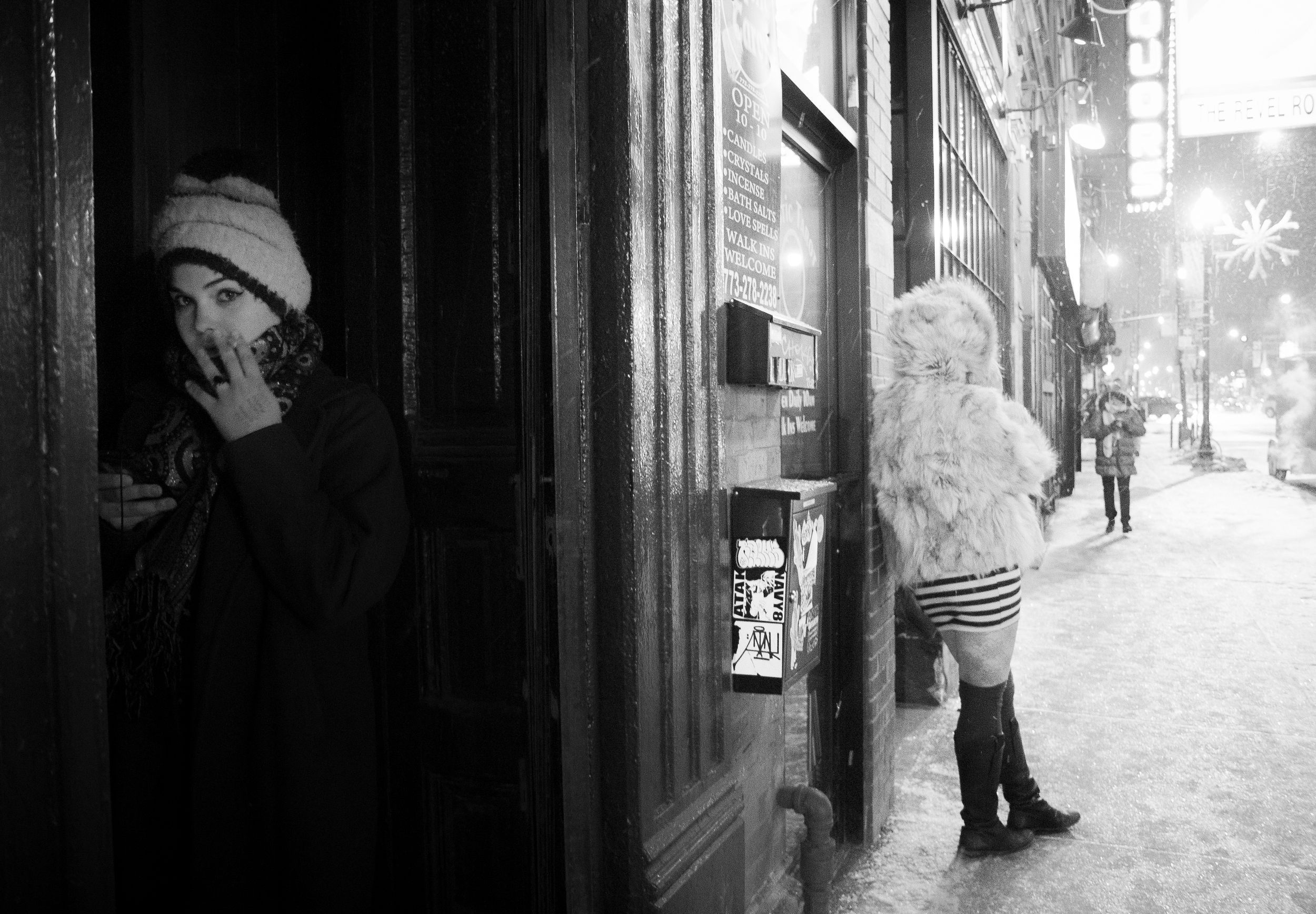
Tension is born out of the confrontation of opposites. Light and dark are in constant opposition with one another, and are associated with opposite feelings as well, as we already discussed in this article. In the photograph below, elements created by light do not act as an extension of the characters, but appear in total contradiction. The beautiful woman rests in the dark, while the strange-looking woman with naked legs is in the light. This inherent contradiction creates a feeling of mystery: the beautiful woman is not who she seems to be. From that dark corner, she seems to hide a secret that she will never share

Tension: What lies beyond the frame

Tension can be created by what is suggested to the viewer. Light in this picture contributes to create an atmosphere of film noir, in opposition with the relatively simple scene in front of us. The fact that the light seems to originate from outside the frame adds an extra dimension to the picture: the mind cannot help but imagine the source of the light, the proximity to the subject, the speed at which it may be coming. So much can be said about not saying too much – like in this picture!

Tension: What's hidden in the dark

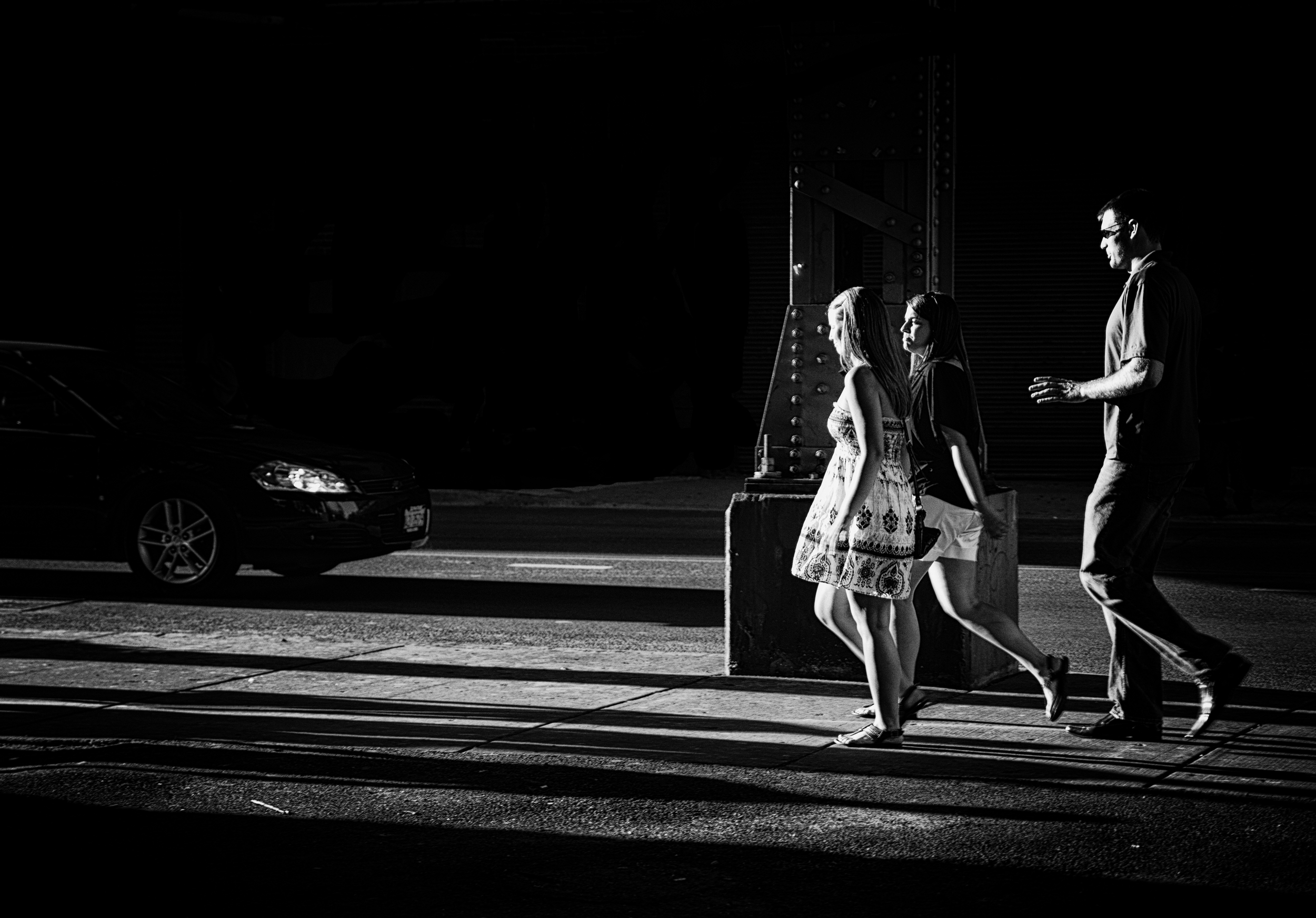
Light can also transform and personify ordinary objects. In this photograph, light is not only acting as negative space. In fact, it brings together two key elements in the story: on one side, the group of people happily walking. On the other side, hidden in the dark, the shadow of a car coming at them. There is a strange and powerful contradiction between those two elements, and the car can easily be perceived as another character of its own – with motives of its own. As a result, the image conveys a threatening feeling, a sense of cinematographic drama that gives a totally new meaning to the image.

Hope you enjoyed this article... and to the next and final chapter of this book very soon!

Storytelling in street photography: Developing subjectivity

Cinema, as an art, has long been using camera angles to create either objectivity (the act of distancing oneself from the scene/subject) or subjectivity (the act of associating oneself with the scene/subject). And indeed, the choice of camera angle will have a deep impact on how the viewer will eventually experience the scene and the story. Will they observe at a distance or will they feel part of the action? Will they identify themselves with the subject or will they react to this confrontation?

Understanding when and how to develop subjectivity is key to creating impactful street images. In this chapter, I analyze and explain the difference between objective and subjective viewpoints: how we can achieve them, and what effect they will have on the viewer. Ultimately, my goal is to help you decide what angles and viewpoints will work best to support and amplify your potential story – thus generating greater emotions and impact with your images.


1.  The omniscience effect

Behind the idea of omniscience lies the principle of showing the big picture. The viewer is given the opportunity to see the scene in its entirety. Long-range and medium-range shots are best fitted to create that effect. Shots that are at eye level (not higher, not lower) will provide the most objective point of view, while lower / higher shots will create interesting subtleties in the way viewers perceive the overall scene. The key to omniscience is to integrate all meaningful elements into one shot: the subject of course, but also all the surrounding context that will extend the story from that of a man alone, to a man within its environment.

Omniscience primarily results from large range shots, taken at the most natural angle possible (straight, eye level etc.)

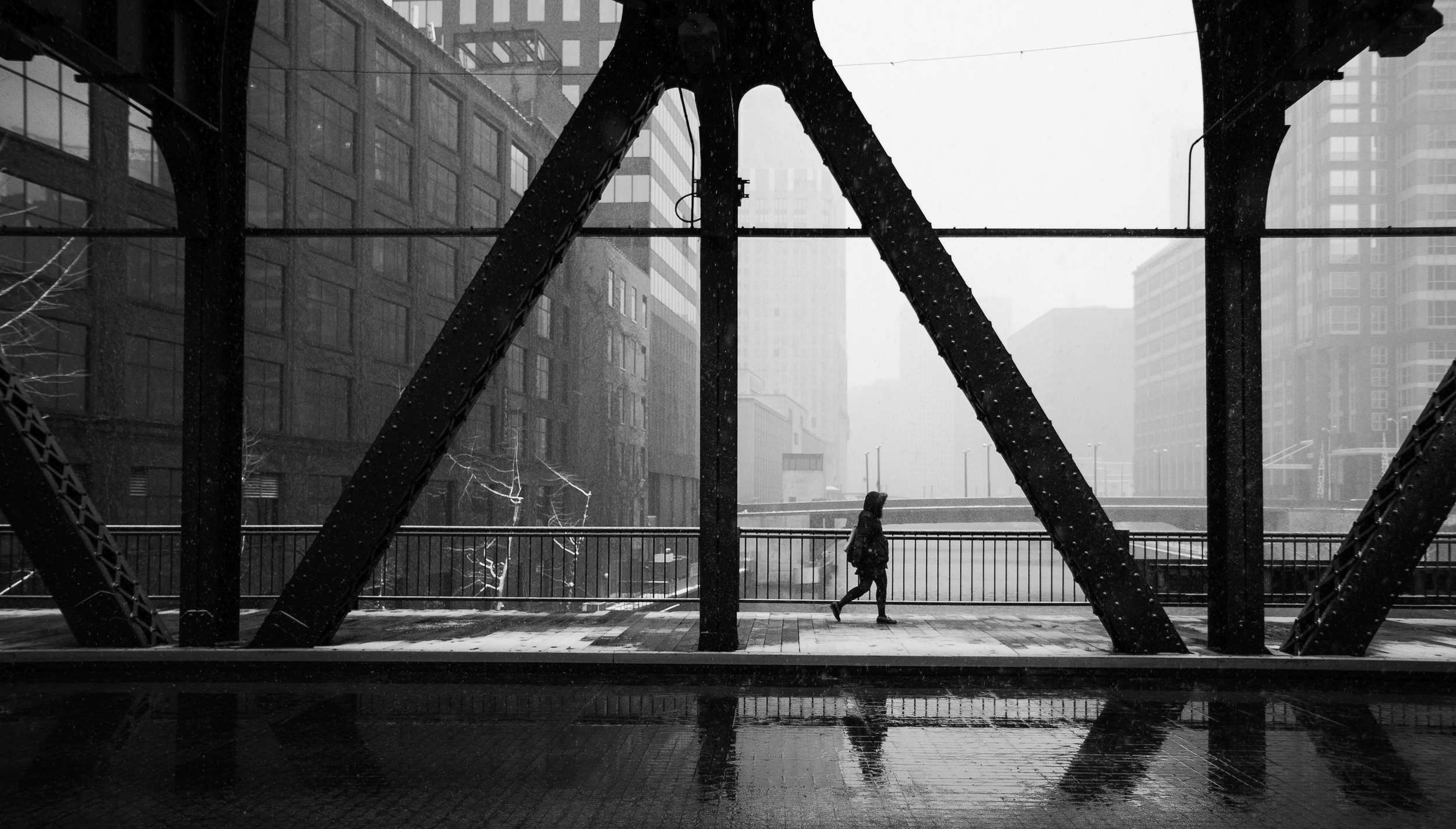
In the above image, viewers are shown the entire winter scene, emphasizing the loneliness of the subject. Without the context of the bridge and fog, that feeling of loneliness would be less strong. It is by distancing oneself from the details that we can see the big picture. The lonely figure exists because of the lonely city – both elements resonate and respond to one another to create a more cohesive story.


2. The experience effect

In films, many scenes are meant to make the viewer feel at the center of the action. As the camera follows the actors, we are often given the impression that we are moving along with the camera… following their every step. When two characters discuss together, we feel in the middle of their conversation – yet the characters never actually look directly at the camera. Most of these tactics will, at least, enable viewers to experience a scene from the inside, not from the outside.  And this is where the magic happens in cinema: from being a mere observer, we become an invisible actor: we are forced into the story whether we like or not.

Experience: Getting close and personal

When you do get closer, your images will often become more experiential.  Close-ups and mid-range images tend to bring the viewer in the story, more so than images taken at a distance.

In this example, the man in the foreground anchors the viewer in the story: the viewer feels as if he was looking through the eyes of this man, and observing the winter scene from his POV. Without the man, this image would be less personal, less subjective. It would portray an urban winter scene from which the viewer is a mere observer (i.e., omniscience effect).

Experience: Shifting the point of view

Tilted orientations, compared with straight orientations, generally add strong subjectivity to your images. When done so meaningfully, the POV becomes highly subjective, as if the viewer was really part of the scene: observing and taking part in the action, yet unobserved – invisible.

In this image, the addition of a low-level angle (the camera is looking up at the man) creates additional emphasis on the subject – making it look more important and imposing than he really is. It also clearly reinforces the subjectivity being created here.

Experience: Learning from cinema as an art

The closer you get from people, the more “voyeuristic” the experience will be, and the more strongly your viewers will experience the scene from the inside – as if they were there, invisible actors of a story that they do not control.

This shot shows a very intimate scene between two lovers, a scene that we can appreciate from very close, not unlike tactics used in cinema to allow viewers to enter the story and identify themselves with the subjects.


3. The connection effect

The connection effect relies primarily on establishing direct eye contact. By doing so, the photographer establishes a strong relationship between subject and viewer – as if the viewer could read the mind of the subject, and as if the subject could see beyond the frame – perhaps even into the mind of the viewer. That connection is so strong in fact that it can be disturbing to the viewer at times. When there is a connection effect, camera angles can strongly influence the feelings associated with the subject and the scene. Taking a shot at eye-level puts the viewer and the subject at the same level – and consequently, establishes a peer to peer relationship. Lower or higher angles will change the equation, resulting in different types of feelings.

Connection: Looking eye to eye

When subjects are looking straight into the camera, a strong relationship gets established. The level of the camera will then determine the nature of this relationship. If the image is shot at eye-level, a sense of equality gets created. Viewer and subjects are on one equal foot – looking eye to eye, peacefully or intensely, depending on the expression of the subject.

Connection: Generating emphasis with low-level angles

Taking your subject from below (what we call a low-level camera angle) will in fact dramatically emphasize your subject. Not equal anymore, the person will appear bigger than real, provoking a shift in perceptions and emotions.

Oftentimes, the viewer will feel overpowered or overshadowed by the subject – associated with a sense of superiority, strength, charisma.

Connection: Minimizing the subject with high-level angles

The opposite is also true, as cinema has shown many times. Shooting a subject from above will result in minimizing the subject, giving it less importance, less strength. These types of angles can generate a sense of vulnerability, of a need for protection. It gives a sense of inferiority to the subject who appears to be lost within the scene.

Hope you enjoyed the reading! To the next chapter, I wish you a very good day :)

Storytelling in street photography: 5 rules for embracing the moment

Capturing the moment is a matter of seconds, even less. There are so many parameters and variables to take into consideration that it can sometimes feel impossible to achieve; and when we finally get that perfect shot, we may tend to believe that we’ve been lucky. Well, believing so is a mistake. Luck is important of course, but ultimately, it is your attitude to openness and possibilities that will determine your success. In other words, let’s give “chance” a chance to come upon us by choosing the right state of mind.

In this short chapter, I wanted to bring to your attention 5 rules that I believe will enhance your journey into street photography. By following those rules, you will start to see so much more than what you’ve seen so far: not relying only on luck, but on yourself, on your inner capability to seize opportunities, and to capture this ultimate story. So trust yourself, first and foremost. Be fearless, be focused, be ready. The world is made of so many opportunities – we just need to look around and be brave enough to seize them.

Key rules:

  1. Become fearless
  2. Never lose focus
  3. Forget the technique
  4. Fail often, try again
  5. Embrace mindfulness

Rule #1: Become fearless

Easier said than done, granted. It took me two years to learn to be fearless – fearless of people, of the rain, of the night. It’s natural to fear, but it won’t take you anywhere. Eventually, it only deters you from enjoying the experience, and will fill you with never-ending regrets.

The key is to understand that nothing bad can really happen to you: slowly, by getting a little more fearless every day, you’ll discover treasures of bravery in you. And little by little, you won’t fear anymore – but it takes time and determination! In practice, you will meet a range of emotions from the people that you shoot without prior authorization. Don’t let yourself be deterred by that – just smile, and move on. From experience, they most likely won’t run after you.

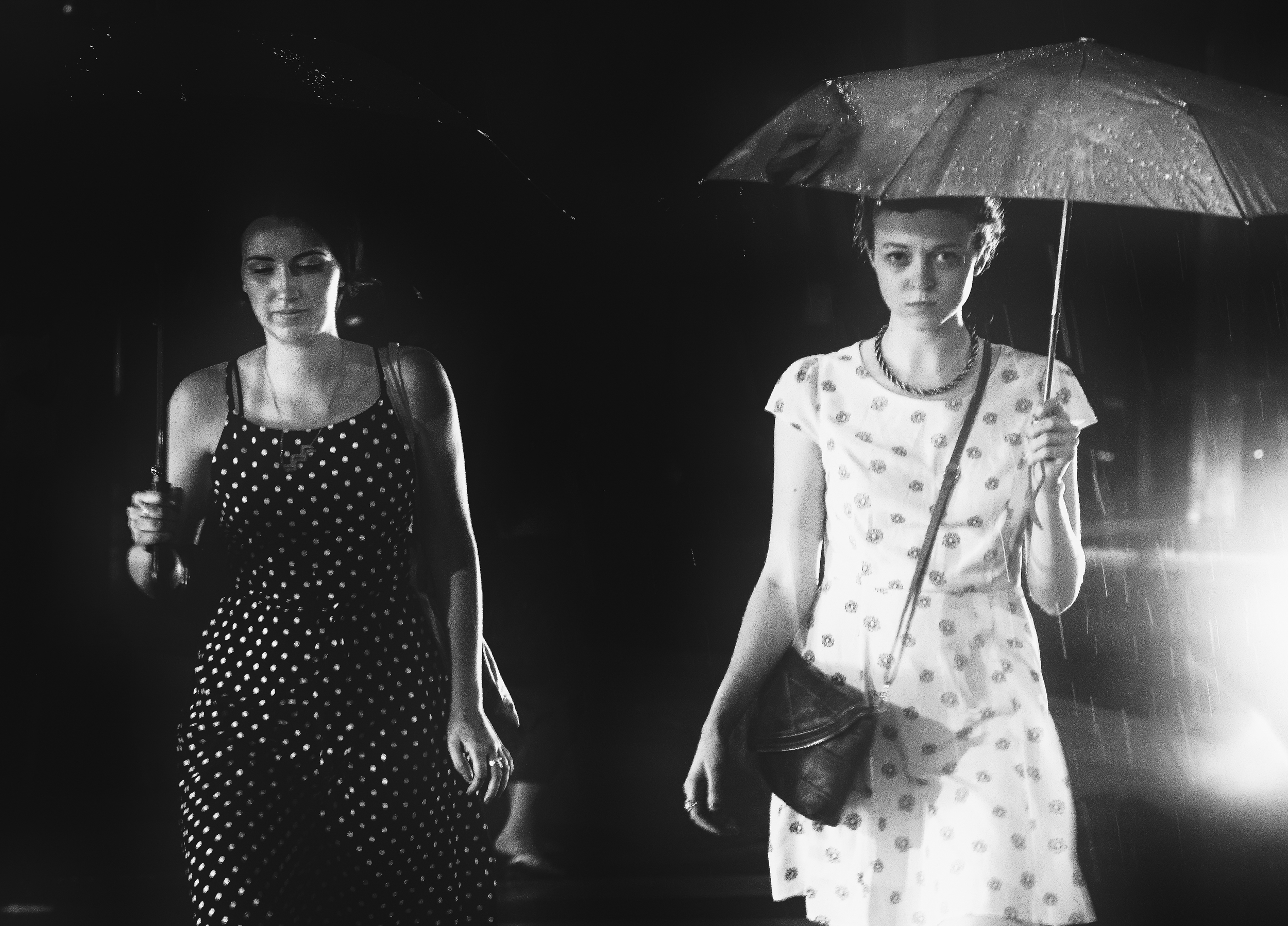
This shot for me represents a turning point. I was shooting at a distance for quite a while, until I got bored with my own fear. I positioned myself very close to that woman, drenched by the rain and half hidden by the night, and I got one of my favorite shots ever. The woman looked at me, surprised at first, annoyed next. What I did? I moved on. I just smiled, and moved on. And I left my old fears behind, forever.


Rule #2: Never lose focus

Opportunities can arise everywhere, at the most unexpected moments – there’s so much you can do to anticipate that particular instant when all elements will come together, perfectly, and meaningfully. Therefore, talented photographers remain focused all the time when they’re out shooting: they let go of distractions that may take them away from that perfect story.

When I am out shooting, I sometimes feel that nothing else exists but me and my camera. My eyes keep scanning the environment looking for opportunities, while my mind is immersed in a fantasy world of my own: a world where new stories come to life.

Yes, I have learned to remain focused, at all time. When I saw the opportunity to shoot that little girl in the bus in San Francisco, I pre-focused my camera on her, and waited for her to turn her head. When the flow of light came by the window, I shot instantly. I had no idea that the bus would turn at the next crossroad, allowing light to flow in freely. But I was ready, and I was focused.


Rule #3: Forget the technique

Street photography is a matter of half seconds – rarely more than that. During that period of time, you need to focus, compose, and trigger the shot. This is why shooting in manual is almost impossible for most street photographers: you just do not have the time to adjust that many settings. Think of it this way: you may be quick enough to adjust one variable – whether this is speed, ISO, aperture, focal lengths or focus distance is your choice. The second variable is your own body: getting closer, getting lower, changing your viewpoint…

All this also takes time. Therefore, I would highly recommend to minimize the technique when doing street photography. Focus on seeing the picture, rather than achieving technical perfection – and as importantly, let go of your old manual habits or you will systematically miss the moment.

Like many of the shots that I have taken with my Canon 60D, this image was shot using a large aperture (f2.8), and automatic speed and ISO. My only decision was to come closer or not, which I decided against to keep the meaningful context of the crowd of customers. The waitress disappeared 2 seconds after, which was just enough time to get that image.


Rule #4: Fail often, try again

Waiting for the perfect shot before shooting the trigger will only get you that far. So many good shots have come from less than perfect circumstances, from an intuition of good shots – but definitely not certainty of it. Because there are so many variables that we can’t possibly anticipate, we are bound to fail often. However, if you don’t give it a try, what are the odds of success?

I truly believe that this is through trying and practicing that we can get better results. Consistency in the effort is at least as important as talent in street photography: so go out and try. Don’t be afraid to fail, it’s ok. We fail often, and we try again. 

I personally shoot a lot – taking maybe 300 shots per 1.5 hour session. A really small proportion of those will ever see the light of the day, of course, but I am often surprised to see how some of the less “wow” shots can turn out to be on my computer. In fact, I rarely know what will make a great shot vs. an average one before actually taking the shot, and sometimes after analyzing the entire scene at home.


Rule #5: Embrace mindfulness

Mindfulness means being in the present – not looking in the past, not thinking of the future, but being, physically and psychologically, in the present and the present only. What this means for a street photographer is simple: stay open to the unexpected, the unpredictable. Never expect anything, just watch and see; this is by doing so that we can let miracles happen.

If you go out with a clear and preconceived idea of the perfect scene, what are the odds that you will find it? Not only will you wait for something that will never happen, but you will fail to see other opportunities arising all around you. If you know so badly what you want, why don’t you stage it? There is no value in trying to force destiny: things happen, or they don’t. Instead, anchor yourself in the present moment, and let the world surprise you.

This is by practicing mindfulness that I was able to take this shot – not consciously realizing its potential, but intuitively feeling that a story was born. I had never attempted to take this type of shot before, but the idea came to me right when the bus was passing in front of this woman. I took one single shot, it was the right one.


And never forget the rule of all rules: Never take it for granted. Keep in mind that you’ll be told many things in street photography, but that only you can know if that’s relevant to what you want to achieve. So never forget that: you’re in control of your art. Do whatever you like, cross all boundaries, deny fundamental rules. Play and experiment. Never surrender to the biggest voice in town.

Have a good day, and to the next chapter!